An Embarrassing but Formative Worship-Leading Lesson from 30 Years Ago

I remember the incident as if it occured yesterday, though it’s been over 30 years, because of how profoundly it shaped the rest of my career.  I was leading congregational singing for a Sunday night service at the church where I truly cut my teeth as a worship leader.  I would have been 28 or 29 at the time, old enough to think more highly of myself than I ought, not old enough to have been humbled with any great regularity.  We had a guest pastor that night, a gentleman who, not too long after this incident, became a good friend, someone I admire deeply.  (In fact, when I became the chapel director at Judson University, I invited him to speak frequently.)

MitmanHis sermon that night was titled “The Brush of Angels’ Wings. . .,” so I knew exactly what I was going to use as the table-setting song.  Though this was a decade before I enrolled in the Robert E. Webber Institute for Worship Studies, where I learned the concept of Scripture-shaped worship (thank you, F. Russell Mitman), I was already keen to the idea that there should be a sense of flow in worship, and my job as a worship leader was to facilitate as seamless a transition as possible between the congregational singing and the message (and any other elements of the service; I was serving a good, low-church Baptist congregation, so we were two-fold all the way).  Indeed, was there any possible choice other than Lanny Wolfe’s “Surely the Presence of the Lord Is in This Place”? For those born in the past 50 years, Wolfe was kind of a poor man’s Bill Gaither; both had a trio, and both wrote a lot of songs.  To be fair, many of Wolfe’s were pretty good; I liked (and still like) his jazzy chords in “Surely.”  Would that today’s cwm writers branched into some of Wolfe’s harmonic territory.  (See the previous blog post.)

I can’t remember what other songs we sang that night, but when we came to “Surely,” and we got to the line that says, “I can hear the brush of angels’ wings, I see glory on each face,” I smiled inwardly.  I had nailed it.  “Isn’t our guest preacher going to appreciate how well I’ve paved the way for his message?” I mused to myself.  Finishing up the last chorus (which had been preceded by a nice modulation from C to D-flat, I might add), singing the title line one final time, I closed in prayer, thanking God for His omnipresence in our lives, and made my way back to the soundboard, where I was recording the message for posterity.  “Job well done,” I thought.

My contentment didn’t last long.  Our guest began by listing several books that had recently been released, all of them touting New Age weirdness under the guise of Christian spirituality.  These were not Christian mystics, embracing elements of historical and Orthodox Christian faith that, for however other-worldly the experiences, nevertheless pointed at all times to Christ.  This was nutty stuff, and a segment of American Christianity at that time was buying it hook, line, and sinker.  The preacher, rightly, exhorted Christians to eschew such fluff and banish it from our daily lives . . . every element . . . even, especially, our worship services . . . even, especially, our congregational singing.  “And forgive me,” he said, “but I must say this because it illustrates the point.  The song we just sang a minute ago. . . .”

I don’t remember much after that.  I do recall slinking down behind the sound console as best I could, a rather forlorn hope for a guy my size.  And I do recall, English major (two degrees) that I am, checking out the bulletin and seeing what I had obviously missed when I was doing my pre-service research: the question mark at the end.  The sermon was actually titled “The Brush of Angels’ Wings. . .?”  I had set the table for the speaker, all right, but with a negative example to prove his point.  
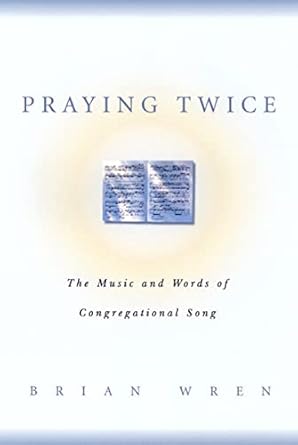
WrenWhat’s the big deal?  Two things, both related to the spiritually formative importance of the lyrics we sing in worship.  There is mention of hearing the brush of the wings of living creatures in Scripture (Ezekiel 3:1-15), but it’s not a soothing sound.  Far from it; there’s unsettling loud rumbling, and when the Spirit lifts Ezekiel away from this scene, he “went in bitterness” and anger–not the warm-fuzzy imagery Wolfe concocts for his song.  Moreover, the title line alludes to Jacob’s encounter with the wrestling angel in Genesis 28 and Jacob’s pronouncement upon waking from his dream.  But notice the tag: “Surely the Lord is in this place–and I didn’t know it!” (emphasis mine).  Jacob sensed God’s presence only after the fact; he didn’t celebrate God’s being with him based on in-the-moment sensations.  Jacob was walking by faith, not sight here; Wolfe’s lyrics celebrate sights that inspire faith.  It’s a subtle but important difference, particulary where corporate worship is concerned, in a world that often clamors for the miraculous as a precursor (or, at best/worst, corequisite) to belief (Matt. 12:39).  (I owe the second of these revelations to Brian Wren and his marvelous Praying Twice: The Music and Words of Congregational Song.)  

Worship leaders, we have the sacred privilege of selecting the words our congregations will sing in praise to Almighty Triune God.  Choose wisely.

The Lord be with you!
Posted in Uncategorized | Tagged , , | 2 Comments

Why I’m Going to Stop Complaining about the Lack of Musical Vitality in So Many CWM Songs, Part I

I’ve had enough. It’s driving me nuts. I’m done.

Thirty-five years ago, in the wake of the TV evangelists’ scandals, I wrote a Bob-Dylanish, righteously indignant, finger-pointing song slamming the hypocrisy and hedonism in the Church on display for all the world to see. I don’t consider myself a songwriter, but I have penned a handful of songs over the years, and I was happy with this one. Here are some of the better lines of the screed:

I’m sick and tired of churches trying to find new ways grow, / More concerned with their numbers than with letting their light show. / I’m tired of deacons decorating buildings nice and neat, / While turning their backs on their brothers that are living in the street. / Materialism’s sanctified, new holy ways to lust. . . .

I’m sick of Spraynet Samuel, looking who he can slander next, / So self-absorbed and pompous, taking verses out of text. He say, / “Riches here on earth, rewards from up on high / From Sugar Daddy Jesus, our Santa in the Sky.” / I guess Donald Trump’s a prophet, and Mother Teresa’s a Pharisee. / Yeah, I surrender all to Jesus, just let me keep my LTD. / Ol’ Ananias and Sapphira, alive and well on my TV. . . .

Donald Trump was just a very wealthy real-estate mogul back then. Who knew?

20240603_210435

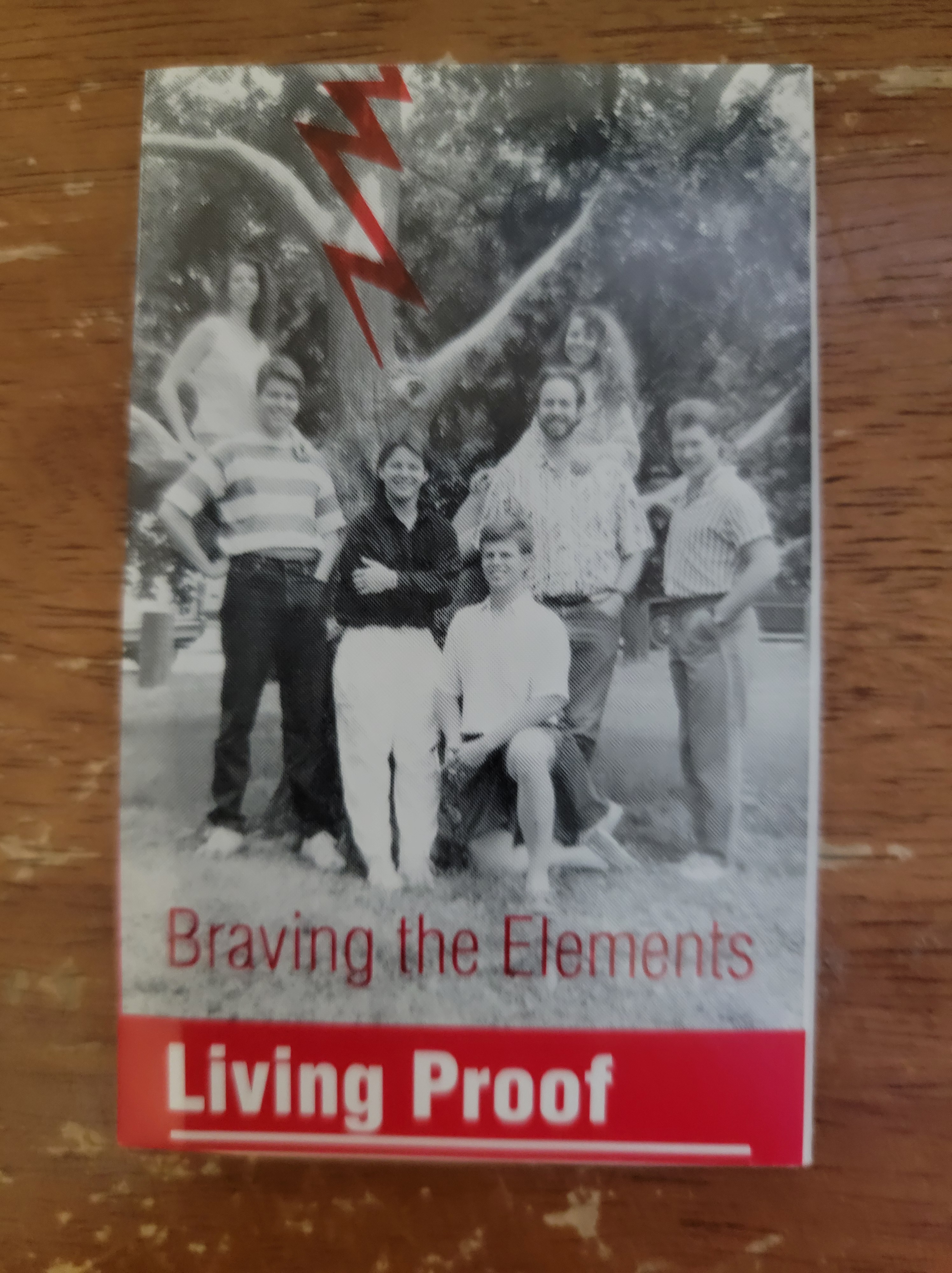
It was a pretty darn good song. I set it as a minor-key blues (think “Green Onions”), my producer buddy Tony Wold put some killer horns and slap bass on the track, and it was a popular song for a short season with the band I led post-college, Living Proof (although not quite as popular as my abstinence-awareness exhortation, “Keep It to Yourself”). But part of the reason I think the song was successful was not that it so effectively judged obvious areas in the Church sadly ripe for the picking (it did, indeed) but because of the punchline at the end of each verse: for verses 1 and 3 (the latter above), “Basically, I guess you’d say, I’m sick and tired of me”; for verse 2 (above), the same sentiment with the pronoun in the plural, i.e., us. It was easy for me to judge others because my own sins stared me in the face so glaringly. (Earlier in the song, in verse 1, I lamented, “I’m sick of spending all my time meeting my own needs. / I’m tired of TV Moses telling me how to succeed. / I’m sick of living life like it’s a game that’s to be won; / He with all the money is he with all the fun. / I’m tired of spending fortunes buying all my eyes can see. / Basically, I’d guess you’d say, I’m sick and tired of me.”) If you have four and a half minutes, feel free to give a listen to “Sick and Tired of Me.” For a wma rip of a 35-year-old cassette tape, it doesn’t sound too bad. (Thanks, as always, for the media assistance from Prof. Tim May of Judson University.)

Many years later, I find that I’m sick and tired of me again. Here too, I feel Truth is on my side. Here too, the issues are obvious to anyone who is paying the least bit of attention. Here too, my frustration is that I know the Church is capable of so much more. But my attitude is killing me, and it doesn’t help the cause at all.

I have in this space tried my best to point out where the songs being composed for the Church over the past decade or so could be improved. I’ve tried, in my better moments, not to lump all current contemporary worship music (cwm) together, decrying “7/11” ditties in the manner of so many purists before me. In my worse moments, however, I confess I’ve wanted to scream, “YOU CAN DO BETTER” every time I hear a new cwm chart-topper with a boring melody, simplistic harmonic structure, and water-torture-worthy rhythm.

That said, I turned 60 a few months back, and I am bound and determined not to finish up my career as a worship-music Scrooge . . . even if the current situation in cwm only gets worse. I’ve told my wife on many occasions that I have this horrible thought of the two of us, in our dotage, sitting on our porch and overhearing some neighborhood child walking by us on the sidewalk and saying to friend, “How did that sweet old lady ever end up with that grouchy old man?” The potential is there.

So in the summer months, I’m going to try to articulate a plan of action for, well, trading my sorrows where boring cwm is concerned. Despite real reasons to continue to despair, I see rays of hope, and I’m going to choose to hang onto those. I invite any other would-be curmudgeons out there to join me.

The Lord be with you!

Posted in Uncategorized | Tagged | Leave a comment

One Last Lenten-Season Devotional Thought

I grew up low-church Protestant, so the concept of an Eastertide season (or 50 days of Easter) was as foreign to me as the notion that the 12 Days of Christmas commence (and don’t end) on Christmas day.  (If my graduate studies in worship did nothing more for me than give me a healthy appreciation of the benefits of following the liturgical calendar, my money would have been well spent.)  So although I could claim I’m simply highlighting the third day of Easter with this post, I’ll concede to the prevailing low-church notion that Lent and Easter are in the rearview mirror now, and to drag them up means hearkening back to a previous season, albeit recent, as opposed to continuing in the richness of what God does in, with, and through us over the next 47 days.  So be it.

WangerinI have been using the late Walter Wangerin’s Advent collection, Preparing for Jesus, for a while now, but although I’ve also had his Lenten compilation, Reliving the Passion, on my shelf, I have never read it until this year.  Wangerin, who was a Lutheran pastor and a writer-in-residence at Valparaiso University, has always been thought-provoking for me, and Reliving the Passion did not disappoint.  The entire book is worth the read, but a few reflections stood out, none more, well, powerful than the one for Tuesday, the 18th day of Lent, for which the Scripture passage reflected upon was Mark 14:61-62:

He was silent and made no answer.  Again the high priest asked him, “Are you the Christ, the Son of the Blessed?”  And Jesus said, “I am; and you will see the Son of man seated at the right hand of Power and coming with the clouds of heaven.”

After reminding readers that time and time again, in the early part of his ministry and especially after performing miracles, Jesus “charged those who experienced his power to say nothing about it,” Wangerin highlights the difference in Jesus’ response in front of the high priest:

Even when Peter, James, and John saw his celestial glory in the transfiguration–saw Jesus revealed as the fulfillment of the Old Testament–he told them to shut up.

The world would have misunderstood the glory.

The world would have expected a warrior-king, someone triumphant in its own terms.  A winner, you know.  A number-one, against-all-odds, pride-inspiring, tear-in-my-eye, flat-out, all-around, good-guy winner!  A hero.

Only when that characterization is rendered absurd and impossible does Jesus finally accept the title “Christ.”

Christian, come and look closely: it is when Jesus is humiliated, most seeming weak, bound and despised and alone and defeated that he finally answers the question, “Are you the Christ?”

Now, for the record, yes: I am.

And then, a few sentences later, as if his late 20th-century musings were presaging events in America 30 years later, Wangerin writes this:

What then of our big churches, Christian?  What of our bigger parking lots, our rich coffers, our present power to change laws in the land, our political clout, our glory for Christ, our triumphant and thundering glory for Christ?  It is excluded!  All of it.  It befits no Christian,  for it was rejected by Jesus.

If ever we persuade the world (our ourselves) that we have a hero in our Christ, then we have lied.  Or else we are deceived, having accepted the standards of the world.

To be in the world and not of it–so much easier said than done.  (Continued) Happy Easter!

The Lord be with you!

Posted in Uncategorized | Tagged , , , , , , | 2 Comments

Some Thoughts on Turning 60, with Some Guidance from an Old Friend

I turn 60 at the end of next week.  The stark immutability of that statement, especially as rendered via written words that will live in cyberspace long after I’m gone, reminds me, and not favorably, of previous decade birthdays.  Thirty was a breeze, what with learning how to parent a seven-month-old and no time for introspection, but 40 and 50 were gut punches.  At 40 you’re halfway there (or even beyond, according to some Scripture passages), if you’re blessed, a sobering thought.  I cut myself a bit of slack for the next one; my dad’s increasingly debilitating dementia had warranted his move to a nursing home, and his slow decline had been a constant reminder of the inevitability of my own mortality, driven home with the recognition of my 50 earthly trips around the sun.  I was not in a good headspace the last two years of Dad’s life, so that didn’t help me deal with the big 5-0.  

Avishai-Cohen-MontrealI’d like the passage to 60 to go more smoothly, so I’m gearing up for it more intentionally.  As I thought about how to get through the next week and a half relatively unscathed, I was reminded of some guidance I had received from an old friend in the midst of grieving my dad’s death.  My relationship with singer/songwriter Leonard Cohen was, to be sure, one-sided (we never met), and it came on rather late in his life; as was the case with Johnny Cash, Bob Dylan, Neil Young, and all the old gutbucket African-American bluesmen from the 1920s-1940s, I couldn’t, in my bel canto snobbery, get past Cohen’s vocal quality, or lack thereof, completely missing the McLuhanesque truth that his tonal quality is, in many ways, his message.  When I finally subjected Cohen to the same deep-dive I had given Dylan 15 years earlier, I rose from those waters a convert. 
(For the purposes of this reflection, I recommend Cohen’s latter-day trilogy, Old IdeasPopular Problems, and You Want It Darker, all full of Cohen’s dark humor and wry observations; the posthumously released Thanks for the Dance is interesting, but less “musical” than anything else in his canon, rather like the final album or two Johnny Cash recorded with Rick Rubin, when the former was so sick the latter had equipment set up at all times, never knowing when Cash might be well enough to croak out another song.  Those albums are painful to listen to . . . but maybe that’s the point.  On the other hand, for a chronicle of Cohen’s end-of-career resurgence, check out the glorious concert recordings Live in London and Live in Dublin, both featuring an incredible band and Cohen’s delightful repartee with the audience.)

My “friendship” with Cohen solidified, however, not through his wonderful songs, love them though I do, but through an interview conducted in 2002 by rock journalist Mikal Gilmore, which found its way into an essay, “Leonard Cohen’s Life of Depression,” collected in the author’s 2008 book Stories Done: Writings on the 1960s and Its Discontents.  I remember reading this after my father’s death and feeling as if God had directed me, as only God could do, to this bit of divine truth from the lips of a lapsed Jew recounting the several years he had lived among Buddhist monks at a retreat called Mt. Baldy Zen Center in California:

I went up [to Mt. Baldy] for the same reason by and large that I have done everything: to address this relentless depression that I’d had all my life.  I would say everything I’ve done–you know, wine, women, song, religion, meditation–[was] all involved in that struggle to somehow penetrate this depression that was the background of all my activities.

By imperceptible degrees something happened at Mt. Baldy . . . and my depression lifted.  . . . [My teacher around that time] said . . . the older you get the lonelier you become and the deeper the love you need.  Which means that this hero that you’re trying to maintain as the central figure in the drama of your life, this hero is not enjoying the life of a hero.  You’re exerting a tremendous maintenance to keep this heroic stance available to you, and the hero is suffering defeat after defeat, and they’re not heroic defeats; they’re ignoble defeats.  Finally one day you say, “Let him die–I can’t invest any more in this heroic position.”  From there, you just live your life as if it’s real–as if you have to make decisions even though you have absolutely no guarantee of any of the consequences of your decisions.

As 60 looms on the horizon, I resonate with this passage now more than ever.  If I have a snowball’s chance of transitioning well into senior-citizenhood, it will come most readily if I abandon the heroism that has been my modus operandi for most of my adult life.  From my elevation to patriarch of my immediate family following my father’s death to my de facto status as pater familias of the community which is the Demoss Center for Worship in the Performing Arts at Judson University, I have had ample opportunity in recent years to assume responsibility that ultimately belongs to God, my role in the process, however important, not withstanding.  So . . . here’s to enjoying and embracing 60; here’s to releasing the grip of heroism. For me, at least, one won’t come without the other. 

The Lord be with you!     

Posted in Uncategorized | Tagged , , | 2 Comments

Episode 10 of Pop Music, U.S.A.

Happy New Year!  I wish all reading this post a blessed 2024!

I’ve enjoyed very much trolling through the video archives, strolling down what Robin Williams always referred to as “Amnesia Lane,” and rocking and rolling through these videos these past six months.  Thanks to those who’ve sent a comment my way indicating your enjoyment of Dad’s treatment of music appreciation and the history of pop music.  In partcular, thanks to my cousin, Kathy Lee, for asking me to post these; revisiting these shows that I haven’t watched for several years was fun, and, as Dad says in his closing remarks in this episode, I hope you’ve learned something along the way.

To wrap up this series, Dad provides a quick-and-dirty definition of pop music, one that both illuminates and respects the nature of popular art, its ephemerality and unabashed celebration of the temporal.  Dad’s big thesis always was that, in the words of Marshall McLuhan, art is the “antennae of the culture,” and examining pop art, in particular, brings a wealth of information to bear re: what was happening at any given moment in a society’s history.  He then moves on to two predictions for the future of pop music–attempts to recapture the past (and, 50 years later, we’ve certainly seen this in the cyclical nature of so many re-imagined genres: e.g., punk in the 70s and grunge in the 90s) and a synthesis or blending of styles between genres.

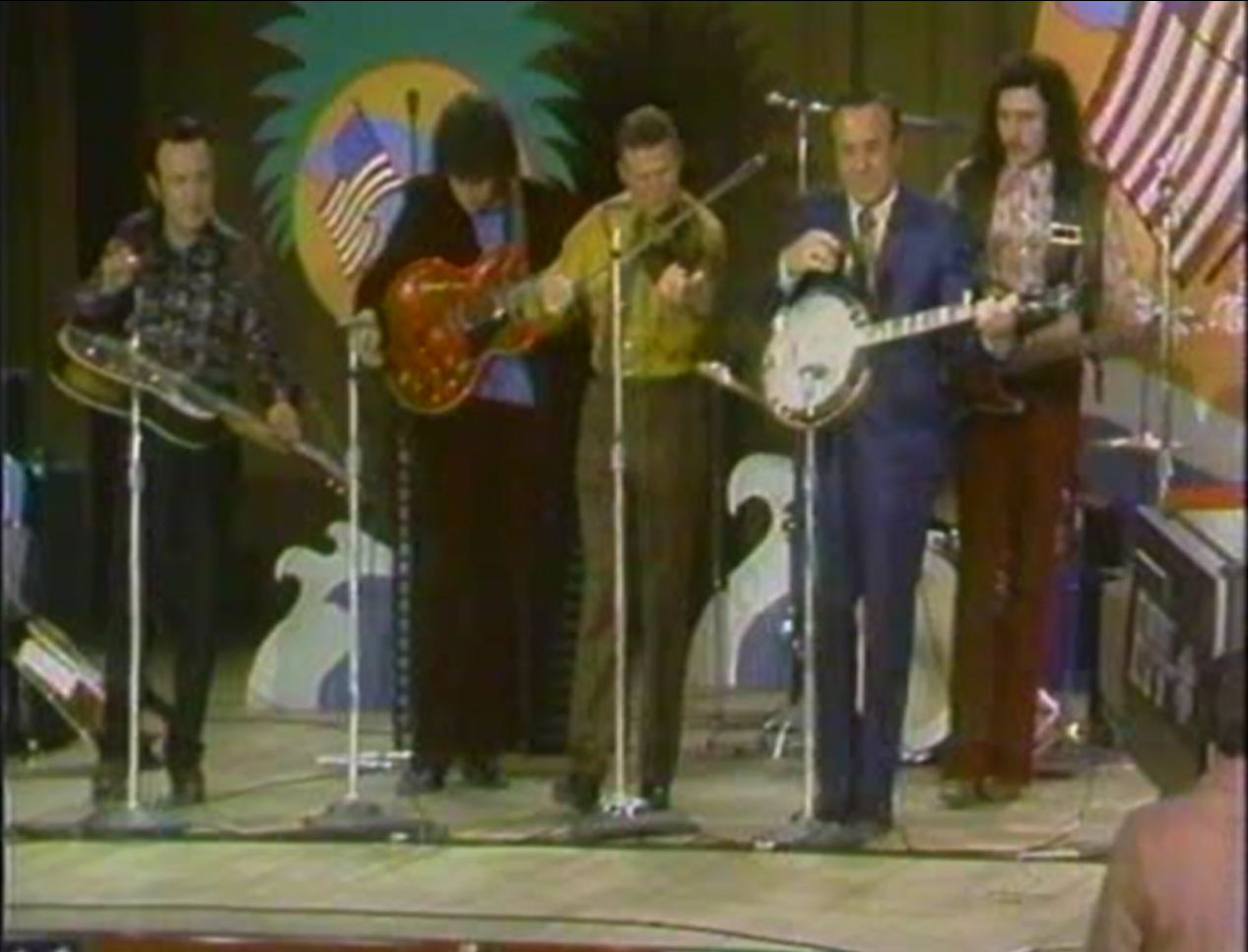
ScruggsTo illustrate the latter, Dad shows a clip of the early 70s Nashville sessions featuring the (perceived) conservative Johnny Cash and the (perceived) liberal (Bob Dylan), captured here singing Dylan’s “One Too Many Mornings.”  (History has shown that, in truth, neither artist was as beholden to the political poles as had been assumed, the clues for which were there if anyone wanted to look for them.)  We also hear some excellent voice-over commentary from the fabulous bluegrass banjoist Earl Scruggs, extolling the virtues of trying out new ideas, while his new band, featuring his sons on various instruments not usually associated with bluegrass, plays a rollicking “newgrass” tune in the background.  I hope you enjoy this series finale.

Thanks again to those who have, in part or in whole, ventured on this journey with me.  I leave you with a few reminders of where we’ve been and a send-off note at the bottom:

scan0068

Dad with recorder

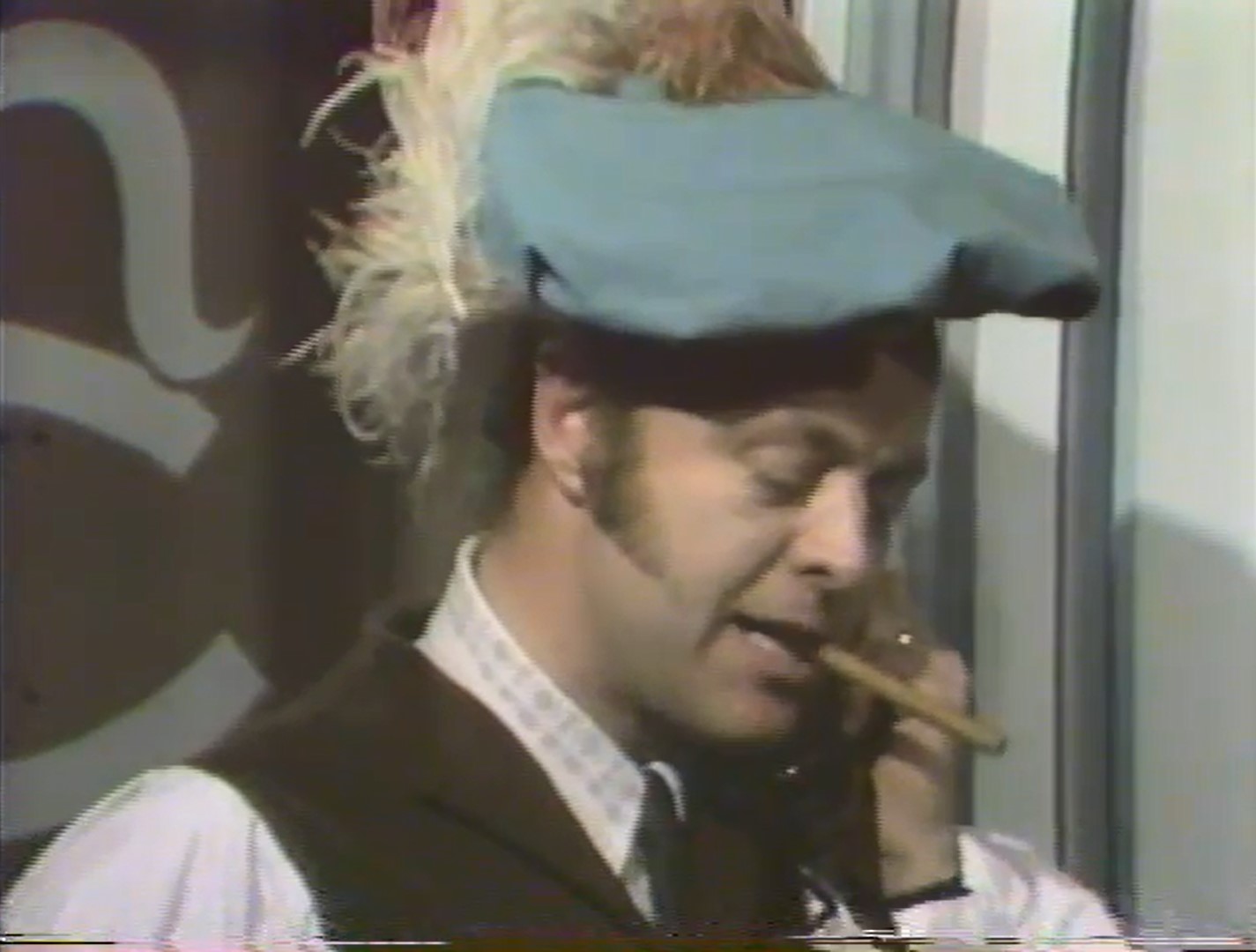
Cigar Dad

quintet

dad-as-jc

Dad as bebopper

Dad as Bing

Dad as Jerry Lee

Dad as Chip Monck

And finally, I know a handful of you receive notes whenever I post, and I’m grateful that a few folks deem what I’ve written over the years to be of interest periodically.  In 2024, I plan to pull back a bit on the blogging; my goal is to post something on the first Tuesday of every month.  There are many reasons for this shift in focus, and I’d be happy to share with anyone truly interested the why‘s and wherefore‘s, but suffice to say that at this season of life, other responsibilities–especially at Judson University–need my attention, and posting monthly instead of weekly is going to help that cause.  I do write a weekly e-mail for the Judson community and beyond, and, if you’re interested in being put on the receiving list for those e-mails, please send a note to my executive assistant, Mrs. Cheryl Richardson, who can be reached at cheryl.richardson@judsonu.edu, and she’ll be happy to add your name to our e-mail roster.  Those e-mails are a mix of Judson-specific news, general information, and what I hope are encouraging words and reflections on life and culture, seen through a biblical lens.  We welcome anyone who might benefit from those missives to join us.  

Until then, I’ll plan to put something on this blog in early February.  Happy 2024!

Posted in Uncategorized | 1 Comment

Episode 9 of Pop Music, U.S.A.

Merry Christmas! I hope you had a wonderful day yesterday and are enjoying the second day of Christmas, you and your two turtledoves.

We wrap up this 50th anniversary celebration of Man and His Music and Pop Music, U.S.A. with this week’s and next week’s posts. (See the 18 previous related posts for more of the back story.) Dad covers the second half of rock in today’s episode. As I mentioned a couple of weeks ago, to make any kind of historically valid claims about a medium that was, at the time of the show’s airing in 1974, merely 20 years old shows an impressive bit of scholarly chutzpah, and one certainly runs the risk of proffering flat-out wrong assessments in an exercise like this. That said, Dad pretty much nailed it when he claimed The Beatles would leave an indelible mark on rock and roll; the fact that I received a copy of Paul McCartney’s mammoth collection of his lyrics, with commentary and a slew of vintage photos, for Christmas this year, 60 years after the British Invasion and 50 years after this episode was filmed, serves as ample testimony. I give him a B for his prognostications re: Elvis and The Rolling Stones (more-or-less accurate for some aspects of their careers). His only flat-out miss (correctly predicted by his guest, rock critic Jim Knippenberg) was re: Dylan. Still, that averages out to a solid B, not bad for an academic at that time, especially one raised on the big bands and bebop.

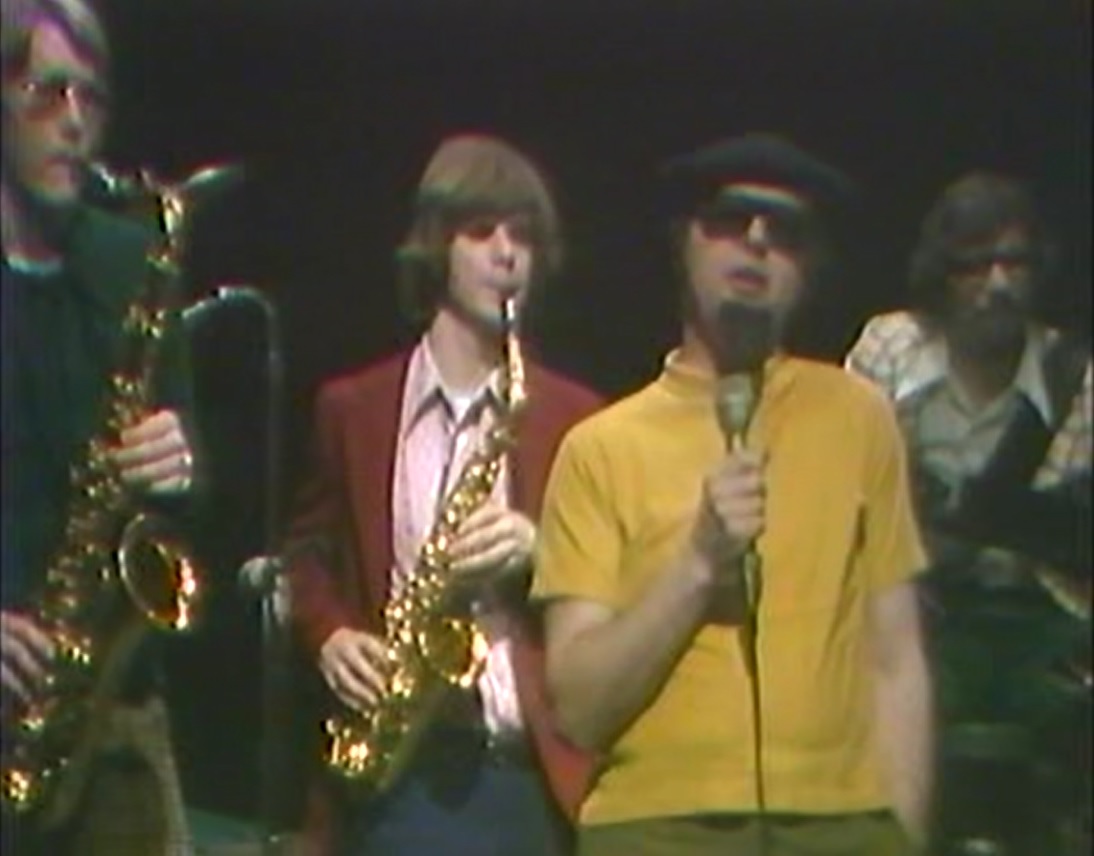
Dad as Chip MonckEpisode 9 begins with my favorite of all Dad’s cold openings, a send-up of the ubiquitous announcements scenes shown in the Woodstock documentary, released a few years before this show was recorded. Dad does a great Chip Monck (yes, that really was his name) and captures the spirit of the festival beautifully. Other moments worthy of note: 1) Dad’s acknowledging The Beatles’ groundbreaking work in the studio (most famously with Sgt. Pepper but in evidence well before and after that seminal album’s release in 1967); 2) his summary of the acid-rock concerts at San Francisco’s Fillmore West: “They must have made the Roman orgies look like a Sunday School class”; and 3) his labeling Janis Joplin “the Judy Garland of the Flower Generation.” The show closes with two songs from a bizarre group called David Hirschberg’s Circus & Bar Mitzvah Band, whom Dad cites as an example of the burgeoning rock-theater movement–another spot-on assertion given where glam and prog rock had been up to that point and where they would continue to go for a few more years. 

I hope you enjoy this look at the rock music, capturing, roughly, 1964-1974.

Posted in Uncategorized | Leave a comment

Episode 8 of Pop Music, U.S.A.

It’s been a few weeks (end-of-the-semester busyness), but I’ll try to finish off this 2023 look at my father’s two public-access TV shows in their 50th anniversary year (well, for the first one, Man and His Music; the second one, at which we are currently looking, Pop Music, U.S.A., debuted in 1974, but we’re celebrating a year early for the sake of continuity).  To recap briefly, Man and His Music was distilled from Dad’s music appreciation class at the University of Cincinnati’s College-Conservatory of Music; Pop Music, U.S.A. featured material he covered in his equally popular history of jazz and pop class.  Both of them featured class sizes of well over 200, with the former, his bread and butter, logging as many as 600 students per term in his/its heyday.

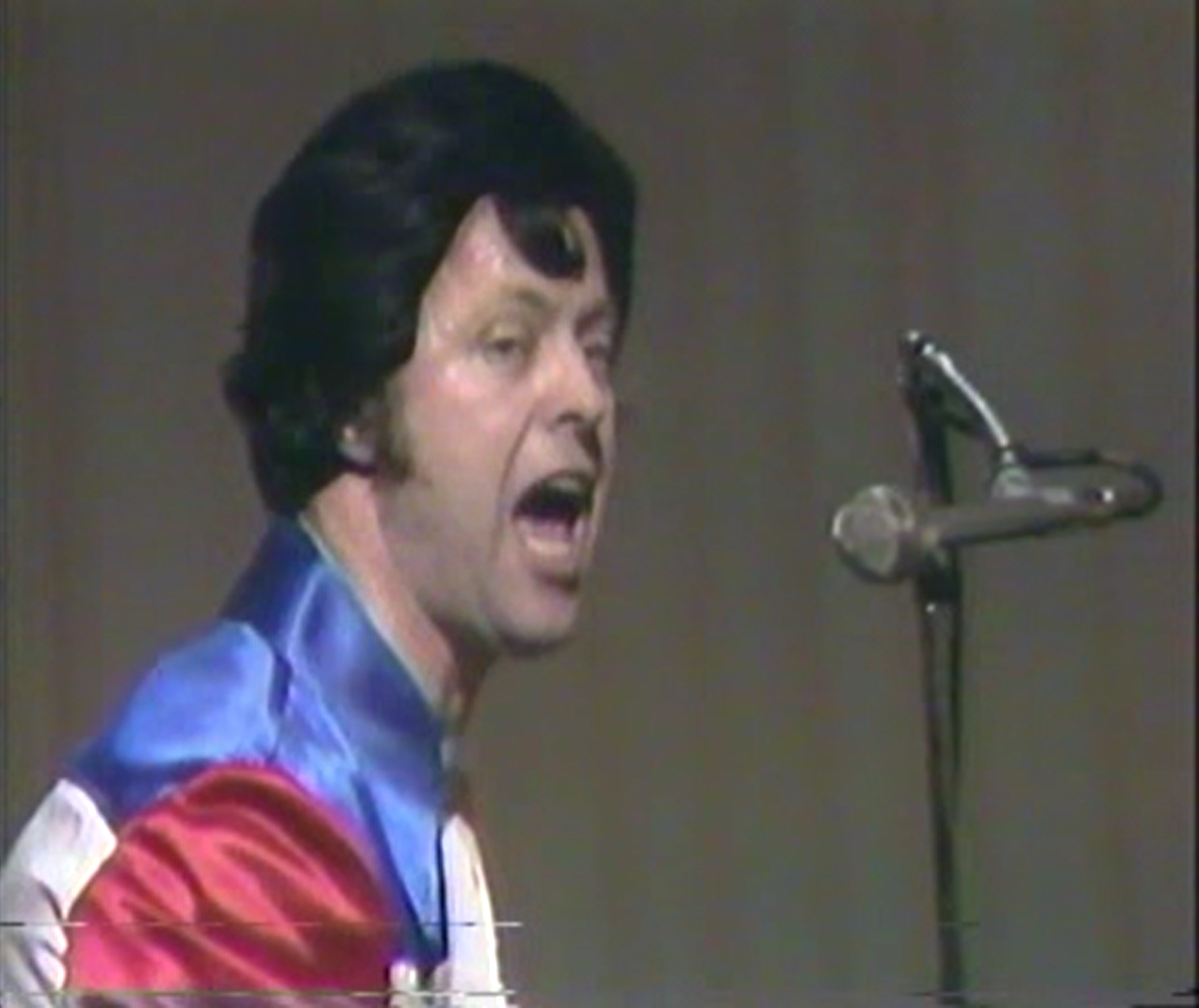
Dad as Jerry LeeIt’s a bit presumptuous, academically speaking, to try to cover a subject historically that’s only 20 years old (1954 being an arbitrary birth-of-rock-and-roll year selected because in July of that year, Elvis recorded “That’s All Right, Mama,” sending his career into orbit and paving the way for so much that followed), but that’s what Dad tried to do with rock and roll in this episode.  In 1974 we had not yet had punk, the commercially popular slice of funk, disco, New Wave, or MTV (let alone grunge, electronica, rap, EDM, and a host of others), and we only had the initial stirrings of glam, the singer-songwriters, and Philly Soul.  But what was out there and discernible, Dad discussed in his usual manner, with looks at the socio-cultural and psycho-emotional overarching frameworks that help inform rock and roll.  And, in this episode, we get Dad the showman, not once but twice, first, in the cold opening, as a Wolfman Jack-type DJ holed up in some kind of ramshackle broadcast studio just out of reach of the FCC; second, as a Jerry Lee Lewis clone playing a spirited version of Bill Haley’s “Rock around the Clock.”  I hope you enjoy episode 8 of Pop Music, U.S.A.

Posted in Uncategorized | Leave a comment

Episode 7 of Pop Music, U.S.A.

Dad as BingThough piano was Dad’s forte, he always had a soft spot in his heart for mainstream pop singers.  In episode 7 of Pop Music, U.S.A., we get biographical snippets of everyone from Al Jolson to the Mills Brothers to Ethel Merman to Frank Sinatra.  The cold opening features Dad as Bing Crosby, complete with fedora and pipe.  (The costume department must have been on vacation that week; the Hawaiian shirt wasn’t a look for which “Der Bingle” was famous.)  At the 19-minute mark, Dad moves from straight biography to academic overviews, including an interesting conversation with musician Al Morgan, who recounts the effort he personally took to see the song for which he is best remembered, “Jealous Heart,” become a worldwide hit.

Episodes 8 and 9, forthcoming, Lord willing, will look at rock.  I haven’t watched these in a while, so I’m interested to see how, in the early 70s, Dad looked at an art form still very much evolving.  Will he have any prescient notions of punk or disco or rap or grunge, none of which was known by those monikers in 1973-74?  We’ll find out soon.  In the meantime, please enjoy this look at mainstream American pop singers.

Posted in Uncategorized | Leave a comment

More Next Week

Work has been a little crazy (in a good way, but still. . .). Dad’s first-half look at the world of rock and roll forthcoming next week, Lord willing.

Posted in Uncategorized | Leave a comment

Episode 6 of Pop Music, U.S.A.

We’re winding down this 50th-anniversary celebration of the public-access TV shows my father, Dr. Simon Anderson, took part in creating: Man and His Music and Pop Music, U.S.A.  If you’re “tuning in” for the first time, the former consisted of material Dad taught in his wildly popular music appreciation class at the University of Cincinnati’s College-Conservatory of Music, the instruction that eventually made its way into his first book, The Musical Imperative, still used in a few schools today.  The latter featured material Dad taught in his more specialized history of pop music class, the title for which doubled as the title of the TV show and subsequent book.

Dad as VaudevillianHaving covered an introduction to pop music, country music, and jazz in the first five episodes, Dad now turns his attention to what he calls mainstream pop, middle-of-the-road fare that encompasses everything from Vaudeville to Broadway.  After the Tonight Show-esque cold opening, in which he plays a fierecely heckled Vaudeville perfomer, he begins the meat of the show by articulating five traits of successful mainstream peformers and then moves into some of his bread-and-butter analysis of the socio-economic factors at work that make the creation of West Side Story, for example, impossible to conceive as a story set in Nebraska.  This was Dad’s forte, creating sweeping generalizations that helped students get a handle on the huge world of music.  Later he accompanies on the piano two vocal grad students who sing examples of Broadway tunes, “I Got Plenty o’ Nuttin’,” from Porgy and Bess, and “Can’t Help Lovin’ Dat Man,” from Showboat.

The final segement in the show finds Dad playing talk-show host to Paul Rutledge, for years a theater expert in Cincinnati.  Their Q & A is a fascinating glimpse at a musical genre in transition: Broadway at a crossroads.  Their prescient commentary illuminates some of what we see a few years later with the advent of a new age in blockbuster Broadway entertainment, from Cats to Phantom of the Opera to Miss Saigon to Rent to The Lion King.  I would loved to have seen Dad dive into all that led up to and contributed to this artistic renaissance.  

Thanks for reading.  Hope you enjoy the first part of Dad’s look at mainstream pop.

Posted in Uncategorized | Leave a comment