
I have argued throughout this series and in earlier blog posts that my father, Dr. Simon Anderson, during his 40+ years of teaching music at the University of Cincinnati’s College-Conservatory of Music, was way ahead of his time in lending legitimacy to popular music forms when the world of conservatory pedagody eschewed almost exclusively any musical art form that didn’t have its roots in western Europe and wasn’t at least 75 to 100 years old. In episode 9, “Historical Periods in Art Music I,” of his distance-learning collaboration with PBS’ Cincinnati affiliate, WCET, Man and His Music, Dad gives several examples of what was then pretty revolutionary music-classroom instruction.
First Dad provides four important caveats to art (and art music) history, understanding more effectively how the arts have been rendered throughout the past 500 years, which includes a populist notion of the pervasive nature of commissioned art and the effect-vs.-cause truths inherent in the epochal changes in stylistic directions we see in art history, with an aside to his favorite pop-cultural theorist, Marshall McLuhan, and the idea that the arts are the “antennae of the culture,” reflecting, much more so than driving, cultural change.
Then, after a look at how most professors cover music in the Renaissance, Baroque, Classical, Romantic, and Contemporary Periods (i.e, with examples from classical music only), Dad takes us through a quick look at what I feel is his most significant contribution to music appreciation, the fact that the same five categories we use for legit music can be applied to any form of popular music, such is the predictability of the ebb and flow of any artists’ responses to the pendular swinging between that which we can distiguish, to summarize simply, as the war between freedom and control. Hence, in what would have been fleshed out over the course of an entire lecture, we get a look at jazz music in each of the five periods normally reserved for the Three B’s (Bach, Beethoven, and Brahms); indeed, in other contexts Dad mentioned the Three B’s of jazz: Beiderbecke, Basie, and Brubeck.
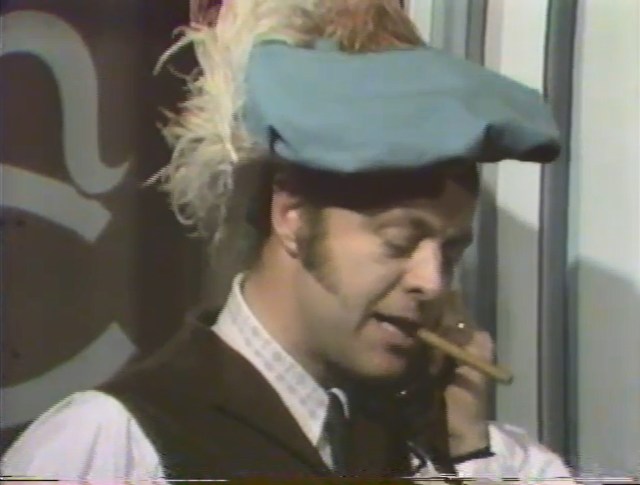 It’s hard all these years later to reflect accurately what a radical notion this was and how revolutionary such pedagogy was then, especially when Dad applied the exact same schema to the other forms of pop music, including country, Broadway, and rock (Elvis = Baroque, Hendrix = Romantic, etc.). All this acknowledged, Dad didn’t care about being right on this subject just for the sake of being right (although he didn’t waver in his belief that he had the proper view on all this). No, he still and always subscribed to the notion that part of being a great educator in the late 20th century traced a line back to Vaudeville entertainers. (To whatever extent that was true then, it’s self-evidently true 50 years later.) So along the way we get treated to a cool brass quintet and two sketches where Dad plays a cigar-chomping member of the ruling class placing a personal order to artists (Hadyn in one, Botticelli in the other) for commissioned art pieces. Never a dull moment when Dad was on stage . . . er, teaching.
Hope you enjoy “Historical Periods in Art Music I.”

 Emmaus Road Worshipers
I have been enjoying watching Uncle Si, I can remember him talking with my brother Donny at piano. One day I remember a conversation they had about the comparisons of classical music and popular music of the late 60’s.
Thank you Warren,
Kathy Freeborn Lee
LikeLike