
Episode 10 of Man and His Music, “Historical Periods in Art Music II,” is Dad at his academic best. Pure scholars who might have rolled their eyes at some of Dad’s attempts to engage the engineers and accountants and nurses and, especially, D-I athletes in his classes with song-and-dance-man antics could broker no argument with this treatment of the traditional historical periods in art music. Indeed, Dad doesn’t touch popular music at all (as he did in the previous episode, showing how the periods apply to jazz as well as classical music) but nevertheless covers the material in interesting fashion, illustrating how “Twinkle, Twinkle, Little Star” might have sounded in the Renaissance, in the Baroque Period, etc.
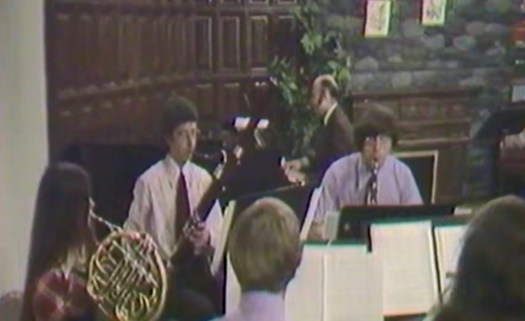 Accompanying him and bringing the concepts to musical life is a group of conservatory students who called themselves the Burnet Woods Wind Quintet. Burnet Woods was, and still is, a lovely park not too far from the University of Cincinnati’s main campus. At around the time of this recording, my mom would often take my siblings and me to play in the park, especially its long cement slide and paddleboats in the neighboring pond. For the Romantic Era offering, Dad joins the ensemble on the piano.
I’m stupid biased, of course, but I found myself LOLing a couple of times with the sweeping generalizations Dad makes here, the kinds of socio-cultural broad-brush painting that allowed his students to get a general sense of what was going on among the people, especially those whose exploits don’t usually get written up in history books. Throughout his whole career, Dad concerned himself more so than most scholars on the relevance of the vox populi, and that shows up in spades here. Dad gives one of my favorite music-history prof money lines in this lecture, while discussing the pendular swing of artistic expression between reason/control and passion/experimentation: “The seeds of greatness become the seeds of decay.” These are, of course, partly contrivances that meet pedagogical needs, and Dad acknowledges that early on, but in this episode it’s clear why Dad was such a favorite professor for 40 years of college students.
Next week, Lord willing, we’ll begin looking at his second show, this one more specifically focused on popular music, the appropriately titled Pop Music, U.S.A. Thanks again for those who are reading and watching these. I hope it’s almost as much fun for you as it is for me. Enjoy “Historical Periods in Art Music II.”

 Emmaus Road Worshipers
I am a good friend of Kathy Freeborn Lee and would like to watch all the episodes. Thanks
LikeLike