A Word for the Anxious

Today I offer the second of seven devotionals written several years ago for Judson students about to embark on a missions trip to India.  The “80 wooded acres” is a phrase often used in the early days of Judson College to describe its scenic beauty–and, truly, if you haven’t been on campus at this time of the year, God’s handiwork is evident all around.  Were I to update this for today’s reader, I would mention white-noise apps for smart phones instead of white-noise machines in hotel rooms, but the basic message would be the same.  I pray this blesses anyone needing a word of encouragement to be strong and courageous today (Joshua 1:9).

♫  “I’ve Got Peace Like a River”  ♫

Isaiah 26: 3 – “He will keep in perfect peace all those who trust in him, whose thoughts turn often to the Lord!” (TLB)

When my family and I lived on campus, first in Ohio Hall and then in the campus apartments, we would enjoy walking around the “80 wooded acres” during the summertime—when, sadly for most of our students, who don’t hang around Judson at that time of the year, the grounds are at their most gorgeous.  One time my daughter Amie, who must have been all of two at the time, was walking with me over the bridge that covers Tyler Creek, when she noticed her reflection in the water.  “Look,” she exclaimed with glee. “Two Amies!” pointing to herself and to her image in the creek.

There’s something calming about bodies of water.  Have you ever seen one of those white-noise machines—so popular among too-busy business folks traveling too many nights and staying in too many hotels?  Several of the soothing sounds that emanate from the machinery when you plug it in have to do with water: the sound of ebbing-and-flowing waves on the beach, a gentle waterfall, raindrops periodically cascading onto a windowpane.  Christian hymn- and chorus-writers have tapped into this concept for centuries.  “Like a river glorious is God’s perfect peace.”  “I’ve got peace like a river in my soul.”

Change gears here for a second, and think about the wisest, most profound, most intellectual professor you’ve ever encountered here at Judson, the one whose wisdom causes you to marvel on a regular basis.  Got one in mind?  Now, with all due respect, consider that person an ignoramus . . . at least where God’s peace is concerned.  Paul tells us in Philippians 4:7 that “the peace of God, which transcends all understanding, will guard your hearts and your minds in Christ Jesus.”  In other words, the most brilliant among us will never get a handle on this peace thing.  Earlier in that same chapter Paul tells his readers not to be anxious about anything, but through prayer and with thanksgiving, to present the desires of their hearts to God.

Most of you will experience a little bit of anxiety at some point in this trip.  Perhaps you’re afraid of flying.  Perhaps you’ll end up getting sick.  Perhaps there are issues at home that you’re leaving behind, and though they will be out of sight for a few weeks, they will very much not be out of mind.  In those moments when the enemy endeavors to steal their joy through worry and anxiety, remember that God will keep His children in perfect peace, when they keep their minds fixed on Him.

Prayer for today:

Prince of Peace, who spoke, “Peace, be still,” and calmed the raging storm, calm the raging storms of our lives on and throughout this trip, that we might not be hindered due to worry or anxiety, so that we might fulfill with confidence the mission to which you have called us.  Amen.

The Lord be with you!
Posted in Uncategorized | Tagged , | Leave a comment

On Spiritual Mirrors

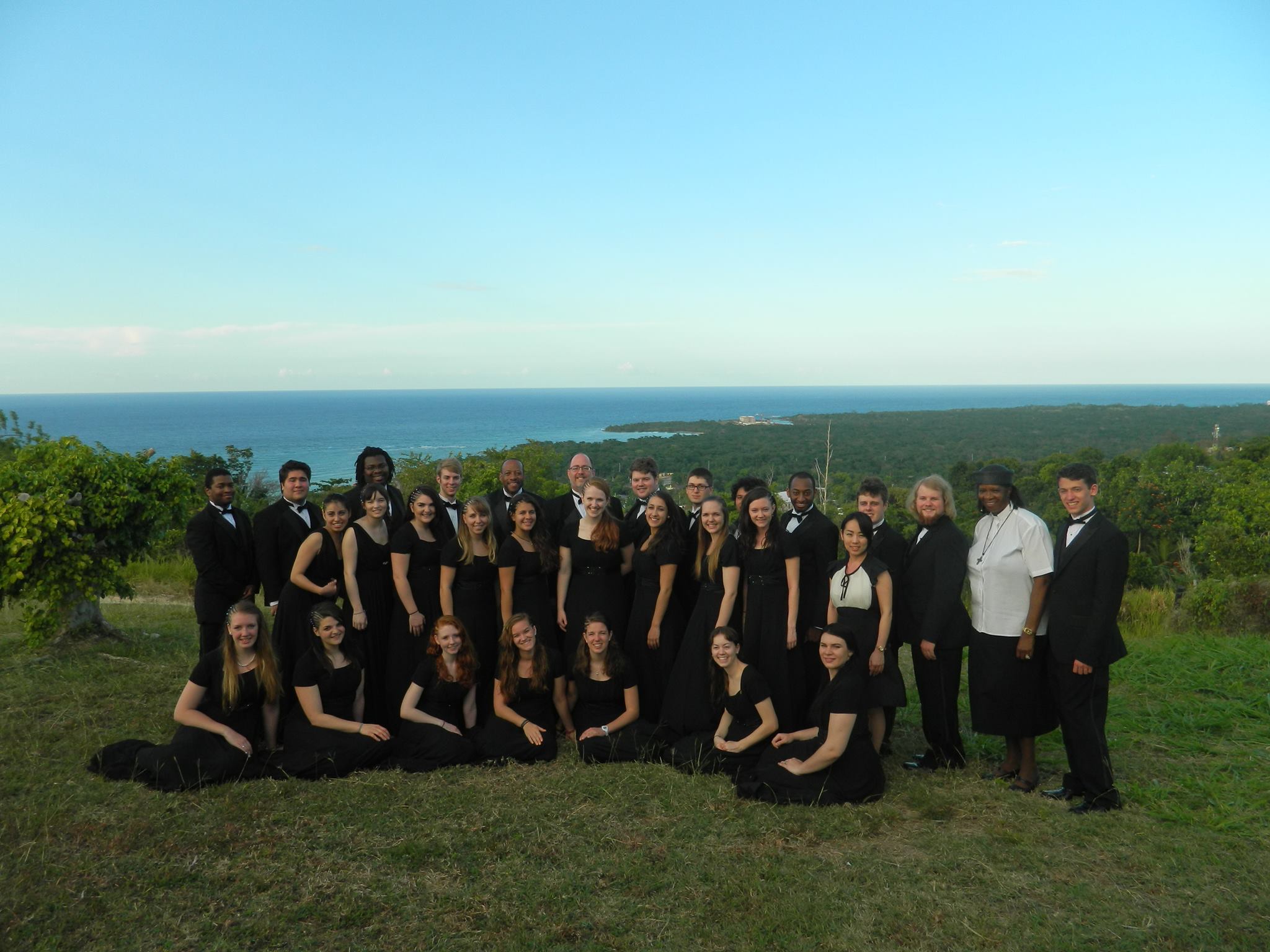
JU Choir in JamaicaMay is often the season in which college students serve on teams doing various ministry work both domestically and internationally.  At roughly this time last year, I was in Jamaica with the Judson University Choir, a life-changing experience for many of us.  We had such a moving time of ministry there that we hope to go back again next May.

The other day I came across a series of devotionals I was asked to write for one such missions trip Judson students took to India about eight or nine years ago.  They were to read them at various points during the trip, one every other day or so, as I recall.  I was asked to address the topic of reflections–what they are, where we encounter them, what they mean (and don’t mean), etc.  As I read through the pieces, I thought to myself, “These aren’t half bad,” and so I plan to share one per week for the next seven weeks, as I get back into the habit/discipline of trying to offer in this blog, well, some reflections on the Christian life, filtered, as often as not, through the lens of worship.  Here’s the first, which focuses on mirrors.

“Mirror, Mirror, on the Wall”

Psalm 139:23-24 – “Investigate my life, O God, find out everything about me; cross-examine and test me, get a clear picture of what I’m about; see for yourself whether I’ve done anything wrong—then guide me on the road to eternal life.” (The Message)

The most obvious word that comes to mind when you talk about the concept of reflection is mirror.  And in our materialistic and self-obsessed culture, we place a high value on mirrors, don’t we?  We stop in front of them to check for all kinds of things: straightened ties, coiffured hair, erupting zits.  We become so obsessed that sometimes one mirror won’t do.  We need three mirrors to make sure that the new outfit we are thinking about purchasing doesn’t make certain parts of us look too big or other parts look too small; when my family moved into our new home, the thing I missed most about our old digs was the three-way mirror above the sink in the bathroom, which came in handy when I tried, as best I could, to comb my thinning hair back so as to accentuate the bald spot as little as possible.

Nathan the prophet was a spiritual mirror for King David, in the aftermath of the latter’s adultery with Bathsheba and subsequent murder of her husband Uriah.  In 2 Samuel 12, Nathan confronts David by holding up a mirror, of sorts, to the king, showing him the offensive ways in him, as the NIV renders the scripture verse for today above.  When David expressed outrage that the rich man in the story stole the lamb from the poor man and served it as a meal for a fellow traveler, Nathan uttered what must be one of the most horrific indictments ever: “You are the man!” (verse 7).  David, to his credit, doesn’t try to make excuses for himself and doesn’t foist the blame anywhere other than where it belongs: “I have sinned against the Lord” (verse 12).  Read David’s sincere and contrite plea for forgiveness and cleansing in Psalm 51.

Your trip is going to be filled with opportunities for self-examination.  Why am I really here?  What are my real motivations?  What good can a bunch of wealthy Americans do here in India?  And, no doubt, some of your innate—thanks to the Fall—prejudices will rise to the surface at some point on this trip.  (Those of you who think you’re not at all prejudiced, that you’re above such pettiness, be sure to check in with your advisors soon, to alert them of this miracle.  They will want to disabuse you of your folly ahead of time.)  When those and other un-Christian thoughts tempt you, remember Nathan’s rhetorical mirror.  It’s a lot less painful to do the spiritual mirror-gazing yourself (in the spirit of Ps. 139 above) than to have it done for you.

Prayer for today:

Omniscient-yet-gracious God, Who knows our hearts and our motives and our thoughts and everything about us, grant us the courage to engage in regular—daily, hourly—self-reflection, that we might have clean hands and pure hearts to bring to You and those whom we will serve on this trip, for the glory of Your Kingdom.  Amen.

The Lord be with you!
Posted in Uncategorized | Tagged | Leave a comment

Brennan Manning on Resting in God

For those of us who follow academic calendars, summer comes to us–at least partially, at least potentially, at least initially–as a period of rest.  The fact that I follow an academic calendar and see that I haven’t written a blog post–an activity I find very enjoyable and soul-nurturing–in almost two months probably attests to how desperately I need a little rest in my own life.

brennan-manningI know of few authors who speak to matters like this with any more clarity and grace than the late Brennan Manning, who died a couple of years ago after a significant speaking ministry on college campuses, among other venues.  For over 20 years, I directed the chapel ministry at Judson University, and Manning’s Spiritual Enrichment Week addresses in the late 1990’s at Judson (then) College were profound, and alums who were Judson students during that time still talk about how profoundly Manning rearranged their notions of grace and their identity in Christ.

In lieu of my own thoughts on this subject, here is Manning, in classic Manning fashion, providing marvelous reflections on resting in God.  This excerpt comes from his well-known The Ragamuffin Gospel:

If a random sample of one thousand American Christians were taken today, the majority would define faith as belief in the existence of God.  In earlier times it did not take faith to believe that God existed—almost everyone took that for granted.  Rather, faith had to do with one’s relationship to God—whether one trusted in God.  The difference between faith as “belief in something that may or may not exist” and faith as “trusting in God” is enormous.  The first is a matter of the head, the second a matter of the heart.  The first can leave us unchanged; the second intrinsically brings change.

Such is the faith described by Paul Tillich in his famous work The Shaking of the Foundations:

Grace strikes us when we are in great pain and restlessness.  It strikes us when we walk through the dark valley of a meaningless and empty life. . . . It strikes us when, year after year, the longed-for perfection does not appear, when the old compulsions reign within us as they have for decades, when despair destroys all joy and courage.  Sometimes at that moment a wave of light breaks into our darkness, and it is as though a voice were saying, “You are accepted, accepted by that which is greater than you, and the name of which you do not know.  Do not ask the name now; perhaps you will find it later.  Do not try anything now; perhaps later you will do much.  Do not seek anything, do not perform anything, do not intend anything.  Simply accept the fact that you are accepted.”  If that happens to us, we experience grace.

And Grace calls out: you are not just a disillusioned old man who may die soon, a middle-aged woman stuck in a job and desperately wanting to get out, a young person feeling the fire in the belly begin to grow cold.  You may be insecure, inadequate, mistaken, or potbellied.  Death, panic, depression, and disillusionment may be near you.  But you are not just that.  You are accepted.  Never confuse your perception of yourself with the mystery that you really are accepted.

Paul writes: “The Lord said, ‘My grace is enough for you: my power is at its best in weakness.’  So I shall be very happy to make my weaknesses my special boast so that the power of Christ may stay over me” (2 Corinthians 12:9).  Whatever our failings may be, we need not lower our eyes in the presence of Jesus.  Unlike Quasimodo, the hunchback of Notre Dame, we need not hide all that is ugly and repulsive in us.  Jesus comes not for the super-spiritual but for the wobbly and the weak-kneed who know they don’t have it all together, and who are not too proud to accept the handout of amazin’ grace.  As we glance up, we are astonished to find the eyes of Jesus open with wonder, deep with understanding, and gentle with compassion.

May that grace–to which we all are, in the words of the hymn writer, “how great a debtor”–wash over you today in profound ways, and may the rest of our God be yours today.

The Lord be with you!

Posted in Uncategorized | Tagged , | Leave a comment

Good Reminders for Worship Leaders from a Night at the Cabaret

One of my nieces, an accomplished singer who has sung in Cincinnati’s renowned May Festival Chorus, this past weekend coordinated a night of small-group Cabaret singing as a fundraising event for the world-premiere production of Morning Star by the Cincinnati Opera this summer.  As my wife and I sat listening to the wonderful music, it occurred to me that the evening was producing some good reminders for worship leaders, even though the event was not held in a church, and we were not gathered for expressly religious purposes.  (For more advice for worship leaders from unlikely sources, consider this excellent post from Willow Creek worship leader Aaron Niequist: Aaron Niequist on Bono as a worship leader.)

1. We were greeted hospitably.  Uniformed personnel opened doors for us, asked us if they could take our coats, and gave explicit directions for how to find the room where the event was taking place.  How often, I wondered, do folks walk into our churches without the faintest idea of what to do, where to go, or how to find what they’re looking for?  I bet more of our churches would retain more of our visitors if those of us in leadership reminded ourselves more regularly what it felt like when we were visitors once ourselves.

2. The room was decorated beautifully.  We entered a performance space that could best be described as “industrial chic,” with tastefully accented lighting and other décor that obviously had been given much consideration.  Someone on the leadership team had been assigned the task of paying significant attention to details that, technically, had nothing to do with the making of good music.  And yet, of course, they did, as the beauty of the environment made us even more receptive to the music than we otherwise would have been.  How often, I wondered, do our churches, in well-intended efforts to focus on the majors and to make sure we don’t distract worshipers, miss opportunities to allow sacred space to inform our worship services–to point people to, rather than distract people from, God?

3. The meal was prepared with excellence.  We were served a four-course meal that was fabulous.  Everything was tasty and presented beautifully.  How often, I wondered, do our churches adopt a penny-wise mindset that ends up being pound-foolish where things like coffee, donuts, and even communion bread are concerned?  In a church staff meetingBob Webber today, one of our associate pastors cited Ps. 34:8, “O taste and see that the Lord is good,” as a rationale for serving extra-tasty bread for this year’s Good Friday service, and I think he has a point (for Good Friday and for any observance of the Eucharist, for that matter).  Near the end of his life, Robert Webber began articulating the strong connection between worship and hospitality.  I suspect many of our churches could focus a bit more energy here.

4. The outline for the evening was made very clear at the onset.  Once the meal had been completed, the emcee for the evening laid out the plan for the rest of the festivities.  Those of us in attendance knew exactly what to expect going forward.  How often, I wondered, do worship leaders fail to “connect the dots” for the congregation during worship?  I fear we sometimes forget that although we have been thinking about this particular worship service for a week or more, although we have been in prayer about all the details (song keys, arrangements, transitional comments) for several days, although we have a significant emotional investment in the goings-on, none of the above usually has been/is in place for our parishioners, many of whom are just finishing up socializing or concluding church business while we launch into our call to worship.  Helping our congregations understand why we are doing what we’re doing can enrich the overall experience significantly.

5. The songs sung were predominantly familiar.  The opera for which funds were being raised that evening concerns early 20th-century American immigrant experiences, and so the songs sung that night came from that era of popular music.  We heard Cole Porter’s “Anything Goes,” George and Ira Gershwin’s “I Got Rhythm,” and Irving Berlin’s “I’ve Got My Love to Keep Me Warm,” among many famous others.  Of the 12 songs sung that evening, I was familiar with 10 of them.  And because I knew most of what I heard that night, I could better enjoy being introduced to two new songs.  How often, I wondered, do we miss opportunities to introduce new songs well because we haven’t allowed our congregations to experience old favorites first?

To extend this analogy much further would cause it to break down, I know, but I appreciated the Holy Spirit’s opening my eyes last weekend to see Truth in areas where I might not have expected it.  How often, I wonder, do I miss other times He speaks to me with insight about the Church when I am in arenas outside the church?

The Lord be with you!

Posted in Uncategorized | Tagged | Leave a comment

A Prayer for Moving from Brokenness to Healing


A few weeks ago, Judson University featured one of my all-time favorite chapel speakers, simkinsRev. Ian Simkins, in a Spiritual Enrichment Week series of messages titled Beauty in the Common, with the word common taking on connotations related both to the ordinary and to that which we do together in community.  (If Ian were the pastor of a megachurch, he’d be an A-lister for youth conferences the world over; he communicates that well.  Connect with him here, if you’re interested: Ian Simkins.)  Ian took four different and seemingly dichotomous word pairings and showed how God brings beauty in each.

I was asked to provide a call to worship for the chapel message addressing both beauty in brokenness and beauty in healing.  I introduced it by noting the fortuitous grammatical inconsistency between the two words.  (Other chapel messages that week featured comparisons between two grammatically similar words: stillness and chaos, both nouns, for instance.)  Brokenness is a noun, while healing can take many forms.  It can be a noun (“I am grateful for the healing God brought to my life”), an adjective (“I want to wade in the healing waters”), or a verb (“Jesus often was found healing the sick”).  I then argued that most of the time, we tend to think of healing as a verb.

So what?  So when healing is used in this manner, it is a present participle, employed most commonly in the present progressive tense, which we use when we wish to articulate that something is ongoing and not finished.  Hence, if there’s beauty in healing, it’s beauty in an incomplete work.  In other words, we are broken people and God, in His grace and mercy, is in the process of healing us, but that work will not be complete this side of eternity.  Thus, whereas we can draw a pretty firm line that separates stillness from chaos, the line between brokenness and healing is quite a bit more porous for Christians.  Embracing this truth allows us to extend grace and mercy to ourselves and, especially, to others along our common journeys as disciples of Christ.

All that acknowledged, there can be a tendency among the young people with whom I work to focus a bit too intently on our common brokenness and miss that the gospel (the “good news”) proclaims our common healing–incomplete, to be sure, but ongoing in God’s perfect timing.  And so for the call to worship, I composed a corporate prayer with responses that reinforced this important understanding of God’s work in our lives.  Recently I was asked to share the prayer as a blog post, and so here it is:

Sovereign God, Great Physician, and Giver of Life,

When the sins committed against us in our childhood—physical abuse, sexual abuse, spiritual abuse, bullying, neglect, abandonment, and many others—when those sins stir up painful memories and cause our souls to grieve, Lord, in Your mercy,

Move us, in Your perfect time, from brokenness to healing.

When the sins that we committed in our youth—lying, stealing, bullying, sexual promiscuity, drug and alcohol abuse, and many others—when those sins come flooding to our minds, when the enemy tempts us to let the past remind us of what we are not now, Lord, in Your mercy,

Move us, in Your perfect time, from brokenness to healing.

 When we agonize over our current lot in life, when we don’t feel as if we have anywhere near the strength we need for today, and we can’t even begin to fathom that You will provide bright hope for tomorrow, Lord, in Your mercy,

Move us, in Your perfect time, from brokenness to healing.

When our burdens feel too heavy to bear, when we sense no one else has ever experienced the depths of despair that we feel, when Your promise to be with us always feels, at best, empty, and, at worst, like a flat-out lie, Lord, in Your mercy,

Move us, in Your perfect time, from brokenness to healing.

When instead of resisting the devil, so he will flee, we invite him into our lives with open arms, believing his lies, entertaining his deceitful manipulations, lending an ear—or two, or even more, when we drag weaker brothers and sisters into our mess—when we lend an ear to the enemy’s destructive falsehoods and nurse and feed his evil thoughts, words, or behaviors, Lord, in Your mercy,

Move us, in Your perfect time, from brokenness to healing.

And finally, when we have, like Job, reached rock bottom, so beaten up—physically, emotionally, and spiritually—that no logical explanation remains for our misery, that we begin to question Your essence and Your character, that we even are tempted to curse You and die, Lord, in Your mercy,

Move us, in Your perfect time, from brokenness to healing.

Sovereign God, Great Physician, and Giver of Life,

Impress upon us Your grace, give us, even this morning, an ever more accurate picture of who You are and an ever more accurate picture of who we are in You, that our responses to those ever more accurate pictures will bring glory and honor to You and Your Kingdom.  We pray in Jesus’ name.  Amen.

The Lord be with you!
Posted in Uncategorized | Tagged , | Leave a comment

Help for Harmonically Challenged Contemporary Worship Music Songwriters

In this space two weeks ago, I lamented the ubiquity of the I-IV-vi-V chord progression (and its same-difference variations) in contemporary worship music (cwm).  Over the weekend I listened to the new release from a worship leader whom I truly respect, whose worship ministry is a fabulous example of servant leadership, and who is dedicated to equipping the next generation of worship leaders.  Three songs in a row fell into this pattern (and at least two-thirds of the entire album went there at some point in the songs).  As I listened, I accurately predicted each tonic-to-subdominant chord change, each submediant-to-dominant pattern.  I used the adjective mind-numbing last time to describe the predictability of so much of today’s cwm, and listening to this new release gave me no reason to relent from that verbiage.  (That said, read last week’s blog for a more complete picture from a worship educator’s standpoint, including a Holy-Spirit-provided punch line that deals with the end justifying the means.)

Long ago I resolved not to be a curmudgeon, occasional predispositions to that kind of behavior notwithstanding.  Hence, it’s been my goal in many areas of life not to complain about something if I don’t have anything positive to contribute to the situation.  In that spirit, then, I would like to introduce two marvelous songwriters whom I am privileged to call personal friends, two men who are making a difference in the Kingdom via worship music, and doing so with a keen ear for what worship leader-educator Greg Scheer calls “the art of worship.”

RoryRory Noland, whose Heart of the Artist books are must-reads for anyone serious about worship ministry, has been creating interesting and singable worship music for years, having served two of the largest megachurches in Chicagoland along the way.  His most famous song, “He Is Able,” features nine or ten different chords, depending on how you calculate things, including a major-seventh of the flat-VII chord, a IV-minor 6th, and both the III and the iii chord.  In case you are unfamiliar with the song, here’s a clip:

Rory’s “I’m Amazed,” probably in my Top 5 worship songs ever (partially because I encountered it at a time in my life when the message resonated with me in significant ways), is a similar feast for songwriters who want to break out of the I-IV-vi-V rut.  Here’s the classic recording of this song:

http://www.youtube.com/watch?v=sZYhvHssiXk

Though these examples are a few years old, Rory is still writing excellent and interesting music.  His most recent offering can be found here: The Lord Is in Our Midst.  I encourage you to pick it up.  It’s full of great songs.

AaronAnother friend budding cwm songwriters should meet is Aaron Niequist, currently serving as the worship architect for The Practice, a contemplative and “liturgical” ministry of Willow Creek Community Church (a church, of course, not generally associated with worship rooted in contemplation or liturgy); it’s a very cool gathering, and if you happen to be in Chicagoland on a Sunday night, I encourage you to attend the service at 6 p.m. in Willow’s chapel.

Aaron is a former student of mine at Judson University, one who has been pushinglogo the envelope, musically speaking, for years.  (For his senior project, he composed a rock opera.)  His latest efforts have been going toward what he calls A New Liturgy, a series of 25-minute worship experiences bringing together all kinds of interesting artistic elements, including congregational singing that stretches beyond the current melodic and harmonic limitations so prevalent in cwm.  If you have 25 minutes, here’s Aaron’s fourth endeavor(two more have been created since), focusing on creation; it will be well worth the time invested:

As I suggested at the end of the previous post, utilizing interesting harmonic progressions in music for the Church need not be a Holy Grail for us, and I remain convinced that there is a sense whereby the end justifies the means where congregational singing is concerned.  That acknowledged, for those songwriters who feel God is calling them to stretch themselves, the oeuvres of Rory Noland and Aaron Niequist are two good places to start.

The Lord be with you!

Posted in Uncategorized | Tagged | 2 Comments

When Contemporary Worship Music Is Boring: A Worship Educator Wrestles with the End Justifying the Means

I am neither a music snob nor a music purist.  As I wrote in my last blog, I am the son of a music educator who revolutionized the world of music appreciation (for all who encountered his philosophies, anyway) by suggesting that Van Halen was as worthy of study as Wagner.  Dad’s understanding of music is my understanding of music; the acorn has not fallen far from the tree.

Where church music is concerned, it was my generation that brought pop music into the sanctuary.  (The fact that we didn’t often do it graciously is lamentable but beside the point for this discussion.)  Over the past 30 years, I have served three different churches for which, in my role as chief musician, I helped make the services more “contemporary.”

CWPA_Stacked_Full ColorAs Director of Judson University’s Center for Worship in the Performing Arts, I oversee endeavors that support a wide range of musical styles, including jazz, gospel, and even bluegrass.  In case the point hasn’t been made completely obvious by now, I love pop music and consider it equally valid in and valuable to the Kingdom as any other musical form.  All of which makes the current state of contemporary worship music (cwm) sometimes frustrating to me.  I don’t want to appear the old fart who pines for the good ol’ days, but when so many of today’s cwm songs feature melodies that could have been written by a middle-schooler, it makes it tough to champion the genre.

When you move from melody to harmony, things don’t improve a whole lot.  The I-IV-vi-V progression shows up with mind-numbing regularity in cwm.  It’s as predictable as the I-vi-IV-V pattern was in early rock and roll.  (“Heart and Soul,” anyone?)  Oh, occasionally on the bridge of a cwm tune you’ll hear iv-IV-I-V, but that’s the same difference.  Rare is the cwm song like “The Greatness of Our God,” which features a truly inventive approach to harmony: the same melody set to different chords in the first four bars of the two verses.

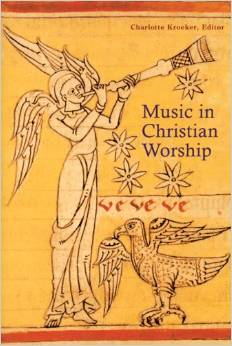
Many worship-music educators would, at this point, point to the supremacy of classical musicKroeker and/or traditional hymnody, arguing against the use of cwm in our houses of worship; do a quick Google search, and you’ll come up with plenty of these opinions.  Let me provide a counterargument from an unlikely source, former Yale professor Nicholas Wolterstorff, whose article “Thinking about Church Music” appears in the Charlotte Kroeker-edited Music in Christian Worship.  He speaks to the role of the worship educator here, and also to the valuable communication-theory understanding of the Rhetorical Triangle, where the audience (pathos) is as important as the speaker (ethos) and the content (logos):

No matter how fond you, the music director, may be of Palestrina and Bach, if your congregation has not acquired the ears for listening to Palestrina and Bach, I do not think it appropriate for you to impose Palestrina and Bach upon them.  Wherever the congregation does have the appropriate ears, then by all means do what you can to keep alive the richness of the Christian tradition of church music as well as honoring what is good in the here and now; but if those ears are absent, then it would be wrong for you to alienate the congregation from its liturgy on some such grounds as that God wants the best and that Palestrina and Bach are the best.

A few days ago I sat in a chapel service that some of my students were leading and listened to many of the same simplistic melodies and tired chord progressions.  At about the time I had mustered up enough angst to commit to writing a blog on the subject, I felt the Holy Spirit say, “Look around you.”

The band was leading the congregation in “Messiah/You’re Beautiful”–with its ad-nauseam I-IV-vi-V progression–and the congregation was as fully engaged as any I’ve ever seen.  I looked across the chapel to see a former student of mine who is going through some real challenges, and then I turned back to the stage to see a current student who just buried his grandfather.  Both were very obviously not concerned with the music’s being inferior, from a musician’s point of view, to that of Palestrina and Bach.  Indeed, they were sold out in worship, clearly being ministered to while singing,

When we arrive at eternity’s shore
Where death is just a memory and tears are no more
We’ll enter in as the wedding bells ring
Your bride will come together and we’ll sing
You’re beautiful

OK.  I’d love to see a iii chord somewhere in that song.  A ii chord would be nice, too.  A flat-VII would enhance the whole experience greatly, in my opinion.  But the end result, at least that morning, of a simplistic melody set to a less-than-satisfying harmonic structure was passionate worship that was changing lives.

Maybe when it comes to corporate worship the Lord occasionally chooses the foolish things of the world of music to shame the wise, the weak things of the world of music to shame the strong.  I will continue to exhort my students to write interesting melodies utilizing more than four chords, but I will also not get too bent out of shape if I sense that the end more than justifies the means.

The Lord be with you!

Posted in Uncategorized | Tagged | Leave a comment

Why I Hope That Sweet Chariot Swings Low for My Dad in 2015 (and What I Need to Remember If It Doesn’t)

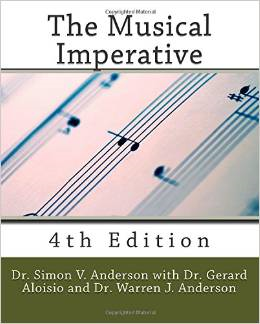
001 (2)My father, Dr. Simon Anderson, shown here with my mother, Nancy, was a professor of music for over 40 years at the University of Cincinnati’s College-Conservatory of Music, one of the best music schools in the country.  Though he started out instructing future band leaders, he soon found music appreciation to be his true passion.  In the early 80’s, I sat at our dining room table stuffing copies of his first book, The Musical Imperative (which he published with his own company, Clifton Hills Press, Inc.), into mailers addressed to music teachers all around the United States.  At its peak of popularity, the text was being used in some 50 high schools, colleges, and universities across the country.

The Musical Imperative (now in its 4th edition) was a distillation of Dad’s philosophy ofTMI music, which can be summed up in a phrase I heard countless times in my youth: “There’s good classical music and bad classical music, good bluegrass and bad bluegrass.”  While this might not seem revolutionary now, in the late 60’s and early 70’s such a statement–along with corollary pronouncements about the worth of all music to be discussed, analyzed, and dissected in the academy–was tantamount to heresy, and Dad was routinely dismissed by colleagues and administrators who couldn’t bear the thought that the three B’s might just as easily be Basie, Brubeck, and “Bird” as Bach, Beethoven, and Brahms.

Yet Dad persevered, taking his egalitarian message to the PBS airwaves in Cincinnati with two TV shows, Man and His Music and Pop Music, U.S.A., both of them simply his classroom lectures brought to a broader audience.  (Many of those viewers for their efforts earned college credit via so-called “correspondence courses” decades before the idea of online education.)  If Dad was compelling in front of hundreds in his classroom, he was scintillating in front of thousands on the small screen, one-upping himself (one example out of many) CWPA_Stacked_Full Colorby not only donning a wig and strumming a guitar, which he did in class, but also saddling up and riding a horse for the TV audience in order to illustrate Willie Nelson’s populist appeal, rooted in such staples of Americana as the Hollywood western.  At every turn, but especially when I sat in his classes when I was a student at UC before I transferred to Judson (now) University, I couldn’t have been prouder to be his son: “That’s my dad!”

That man is gone.  Dad’s dementia, gradually more and more pronounced (in hindsight) over a five-year period, took a serious nose dive when he got pneumonia a few years ago.  The Ph.D who used to hold college students–including several future NFL and NBA players–in the palm of his hand, regaling them with stories from his vast experiences and convincing them to give classical music a try, even as he made sure to give occasional props to their particular preferred genre of music, now can’t string a sentence together.  He is a 37 on a scale of 1-40, where 40 is dead.  Now and again, his eyes appear to light up when a family member is present, but–who’s to say?–that could be gas, the same kind of smiles we get from a flatulating baby.  My father-in-law is fond of the expression “Once a man, twice a boy.”  That’s my dad.

Paul tells us to live is Christ and to die is gain.  I believe that wholeheartedly, and, hence, I really wonder why the Lord doesn’t call Dad home, swinging low the chariot for him, helping him cross to the other side of Jordan, granting him passage on the old ship of Zion as it sails into heaven’s port.  Et cetera.  Dad has lived a good, long, and productive life.  He served the Church Universal faithfully, his initial nominal Christianity taking root into a more-vibrant faith along the way.  His family is ready to release him to his heavenly reward.  I see no earthly reason for him to remain with us.

And yet . . . maybe there’s a heavenly reason that I don’t grasp, limited to seeing through a glass darkly as I am.  Right before Christmas, my wife Lea and I wheeled Dad into the large day room where the residents of the nursing home gather, and I played a few Christmas carols on the piano for him.  I got the usual blank response for the most part–another discouraging visit, my efforts seemingly in vain.

After we wheeled him back to his regular perch in the hallway and walked away to leave, a couple who appeared to be about our age stepped out from a room where someone was very evidently being ushered into eternity.  The husband asked, “Was that you playing?”  When I responded in the affirmative, he thanked me, saying, “We’re losing Mom tonight.  Your music really comforted us.  Thanks.”

And I was reminded once again that we never know when our seemingly random and inconsequential gestures in this life might be used in very purposeful and important ways by our omniscient God, who asks us not to grow weary and to trust Him when we don’t understand.  I hope Dad has met his Maker by this time next year, but, if he hasn’t, I will try to trust the Lord more and complain less.  I don’t do New Year’s resolutions, but, if I wanted to, those two wouldn’t be bad places to start.

The Lord be with you!

Posted in Uncategorized | Tagged | 5 Comments

Reflections on a Near-Death Experience at New-Year’s Dawn

My family rang in the new year a little differently this year.  Our noisemakers and strobe lights came courtesy of an EMT ambulance, whose sirens and blue-and-red flashers helped clear a path to the emergency room for my mother-in-law, who was resting uncomfortably inside following her cardiac arrest several minutes prior.

A few days later I reflected back on those whirlwind 10 minutes or so that saw my mother-in-law brought back from death’s door.  Late in the afternoon, my wife Lea and I pulled into my in-laws’ driveway, having done some last-minute errand-running before all the stores closed down for New Year’s Eve.  Fortuitously, Lea went on ahead of me while I gathered the bags.  When I walked in a minute later, I heard a commotion in the family room and quickly hurried to the back of the house.  There I found a scene out of a fast-paced TV drama.

I’ve read accounts of emergency situations like this, many of them mentioning tunnel vision and the sense of time standing still or, at least, moving in ultra-slow motion.  I’m not sure exactly what I experienced during those frenetic moments, but I do have a handful of images seared into my brain, images that, in hindsight, point to Emmanuel, the God-with-Us whose coming into this troubled world as a helpless infant we had celebrated just the week before.

The primary picture is of my normally soft-spoken wife, typically a picture of decorum, shouting at the limp, lifeless body of her mother–“Stay with us, Mom!  Come back!  We love you!”–manhandling her petite frame as a child would a rag doll as she first performed the Heimlich Maneuver and then switched to CPR when it became clear that was warranted.  Lea was operating on God-given adrenaline, and it was an intense, frightening scene, one which was, depending on whether you were the recipient or the observer of those rescue efforts, either desperately for or definitely not for the faint of heart.

Other visual memories include one sister-in-law, an occupational therapist, rubbing my mother-in-law’s feet using a technique called reflexology, an exercise sometimes found to be helpful during physical crises like heart attacks and strokes.  Another recollection finds another sister-in-law calmly relaying information from the 911 dispatcher, her voice no more agitated than if she had been discussing the weather in the Florida Keys.

And then in my mind’s eye I see my father-in-law and me, both prone to Alpha-male behavior, both of us rendered nigh on useless on the periphery of the proceedings . . . useless unless you count our prayers, in which case we contributed much to the goings-on.  My mother-in-law has had a good and long life, but it hasn’t often been an easy one, so my prayer was simply, “Lord, don’t take her like this!”  If it’s never a good time to die, it’s particularly bad timing to go while your daughter is trying with all her might to resuscitate you.

In reference to my wife and my two sisters-in-law on a recent Facebook post, my father-in-law eloquently wrote, “Had those three angels not been present, Nancy would have remained with her Lord, but He sent her back to continue her ‘work’ in His Kingdom.  What He really expects from her now will be revealed to us at some future date and time.”

Indeed, I don’t pretend to know the mind of God here.  I don’t know why Lea’s CPR “worked,” causing enough blood to course through her mother’s veins for enough time to allow the EMT’s, with their more-sophisticated equipment, to finish the life-saving endeavor–or why one of Lea’s brothers has performed CPR twice, on younger people in ostensibly better physical condition, to no avail.  The Lord giveth and the Lord taketh away.  Blessed be the name of the Lord.

For now, on this 12th day of Christmas, I will simply reflect for a little longer on the Word who became flesh and dwelt among us 2,000 years ago.  He was there, Emmanuel, in our midst that late afternoon and gave the supernatural strength to perform the tasks that were needed, and we are grateful.  And I’ll think on my Bible Gateway verse of the day for January 2, Psalm 90:12: “Teach us to realize the brevity of life, so that we may grow in wisdom” (NLT).  I think all the members of my family are a little wiser these days.

The Lord be with you!

My mother-in-law, Nancy Bahnfleth, was released from ICU yesterday, and, although she has a long road ahead of her, we are optimistic for her recovery.  If the Lord brings her to your mind, we would covet prayers on her behalf.

Posted in Uncategorized | Tagged | 1 Comment

Christmas Points to Easter (via the Ministry of Bob Bennett)

CWPA_Stacked_Full ColorA week ago Saturday, Judson University’s Center for Worship in the Performing Arts hosted one of my all-time favorite singer-songwriters, Bob Bennett, for our annual Christmas Concert of Worship.  Several of our ministry ensembles–our Children’s Choir, Advanced Guitar Ensemble, Chamber Singers, and Civic Orchestra–all ministered in the first half, and then Bob came on after the intermission.  He began with a short solo set, did two numbers with a jazz quartet (for which yours truly served as bassist), and closed with a set of songs accompanied by the Judson University Choir and the Civic Orchestra.  It was a wonderful evening of worship, and part of my reason for including information from the concert in this blog is to introduce Bob to anyone who might not be familiar with his music.  Feel free to check out his website here:  http://www.bob-bennett.com/.

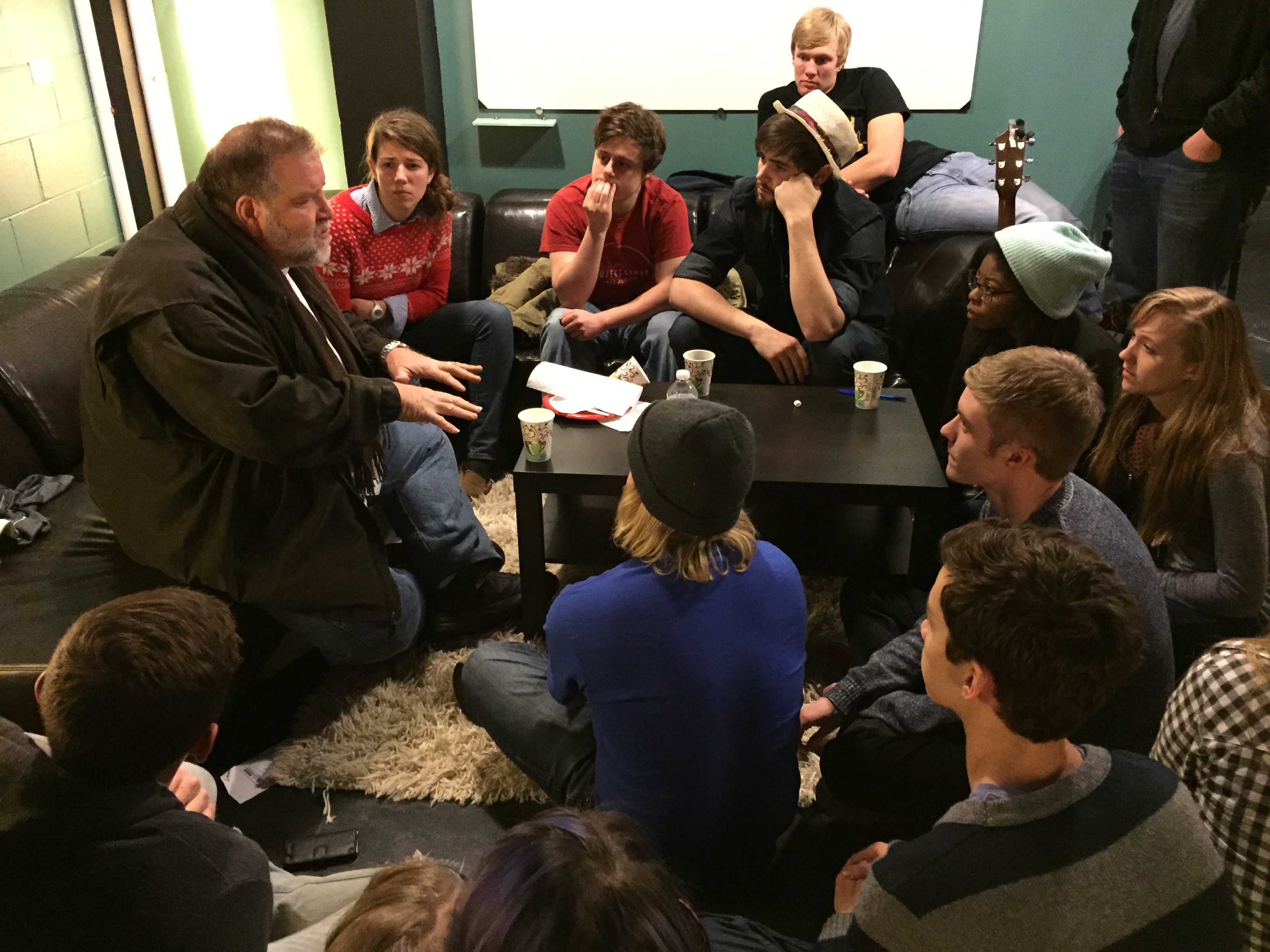
As much as I loved the concert, I probably loved even more the get-together we had afterBob in studio 2 the dress rehearsal on Friday night.  The new addition to the CWPA’s Dark Room Studios was packed with students celebrating God’s goodness to us, and after a bit, Bob ended up holding court with eager students sitting at his feet like so many eager disciples.  Bob was genuine and encouraging, a complete and total blessing to me, my fellow staff members gathered, and the 50 or so students who were there with us.  To be able to bring him to Judson and to expose my students to someone of his caliber–both as a ridiculously talented guitarist and as fellow Christian pilgrim on the journey of life (one who has fonts of wisdom to share with the next generation of Christian musicians and worship leaders)–was a true joy.

I have been a fan of Bob’s music for ages, so much so that my wife Lea and I used his gorgeous rendition of “I Know That My Redeemer Lives” in our wedding.  Here is a clip of that wonderful song, with which Bob closed the concert, a fitting acknowledgement that Christmas points us very clearly to Easter.

The Lord be with you!

Posted in Uncategorized | Tagged , , , , | Leave a comment