
My doctoral thesis looked at the biblical, historical, and theological ramifications of Scripture’s exhortations to sing new songs. Having worked pretty hard during that time to pull together thoughts that would not only pass muster in the upper echelons of academia but also have some benefit for members of the Church Universal not entrenched in grad-school level discussions, I thought I’d share some in this space over the next several weeks.
 The doctoral theses at the Robert E. Webber Institute for Worship Studies must be informed by both Old and New Testament passages. For the OT support, I chose to look at the four Psalms in which exhortations to sing new songs appear in the introductions, or calls to praise: Psalms 33, 96, 98, and 149. From these passages, several principles for congregational singing emerge.
In Ps. 33:3, after the people of God are encouraged to sing new songs to God, they are also encouraged to “play skillfully on the harp, and sing for joy.” Hence, we can infer that we should play and sing with as much skill as we can bring to the exercise. Focusing on playing skillfully, as opposed to excellently, helps us avoid the traps of perfectionism. Paul Baloche, on this subject, says he prayed early in his career for God to grant him just enough skill so that he was not always thinking about the mechanics of playing his guitar while leading worship, a very fine model.
Ps. 96:1 also features what scholars call parallelism, when “Sing a new song to the Lord!” is followed by “Let the whole earth sing to the Lord!” Frank-Lothar Hossfeld and Erich Zenger offer helpful clarification here in their commentary: “The meaning of the term ‘the whole earth’ oscillates in Ps 96 between those who dwell on earth and the extrahuman universe,” thus linking human, earthly worship with the eternal worship in heaven, an Orthodox-Christian focus propagated in evangelical circles by Robert Webber, in his final years, via teaching on the subject of what he referred to as ancient-future worship. Embracing this concept helps us appreciate the subtle-but-important fact that God initiates worship; we do not. 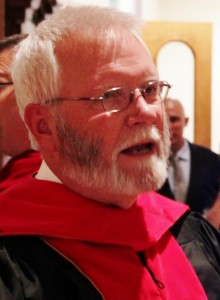 Darrell Harris, chaplain at the Robert E. Webber Institute for Worship Studies, sums up Webber’s thoughts on the subject succinctly:
A central concept of ancient future worship is that God is not the object of our worship. Worship is going on all the time in the heavenlies. Now a resurrected being in the flesh–Jesus–enables us to participate in worship that’s much bigger than we are. We get to do our part. But he’s the initiator, [and we are] not. . . .
When we fully appreciate both our role in worship and God’s, we are much less likely to engage in what Webber often labeled “worship narcissism.”
Robert Davidson, in The Vitality of Worship, his commentary on the Psalms, notes the complete God-focus in Psalm 98, a concept central to Matt Redman’s “The Heart of Worship”:
What is remarkable about this psalm is the way in which it is fixed solely on the LORD and his victory. There is no mention of defeated enemies and no mention of the gods of other peoples, as in Psalms 96 and 97. They have faded into the background. The LORD alone holds center stage…. No psalm more neatly or succinctly lays bare the heart of genuine worship.
Finally, the parallelism found in Psalm 149–“Sing to the Lord a new song. Sing his praises in the assembly of the faithful”–promotes congregational singing in church by all, not just the musically gifted. As a musician, I appreciate music sung well, but corporate worship is not a performance—not for the members of the praise team (who should have some musical skills) and certainly not for the members of the congregation (who may or may not)—so vocal excellence (or even tolerable vocal goodness) among the congregants is not the issue.
John Bell, a leading expert in congregational song, says although one in four, when asked, will claim inability to carry a tune, the actual percentage is significantly less. Moreover, even if we belong to that small group of folks who truly are tone deaf, we do not have license not to sing. I have a friend who most surely cannot carry a tune, and he knows it, yet during corporate worship he sings, off key, as loudly as anyone. He is making a “joyful noise” (Ps. 95:1, KJV), and I am quite sure God is pleased. Once I grasped that concept, I could sing next to him and be pleased as well, because I saw how seriously, even with his acknowledged limitation, he was worshiping. Indeed, helping him appreciate the true nature of a new song sung to the Lord is one of the wonderful deeds (Ps. 98) God has done in the life of my friend. Would that all God’s children receive the same blessing.
Next week, I’ll plan to look at NT congregational-singing lessons. The Lord be with you!


 Emmaus Road Worshipers