
Friends, I pray this year’s Holy Week, with its attendant discombobulation re: anything resembling normal ecclesial protocol, ends up being profoundly influential in your lives and, for worship leaders and pastors, for the flocks you shepherd.
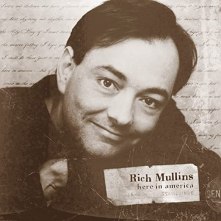 During my shelter-in-place time, I’ve been getting a head start on my usual summertime activity of prepping for future classes and considering music for the Judson University Choir, which I have the honor to direct. A few days ago, I slipped in a DVD I hadn’t watched in quite a while, Rich Mullins’ Here in America, recorded live with a small audience in a studio in South Bend, Ind., in 1993 (used copies still available at a good price). I’ve written before about the few brief opportunities I had to rub shoulders with Rich, a blessing I appreciate more and more the older I get. He was, as I said this past year while introducing the JU Choir’s rendition of his “If I Stand,” a poetic and prophetic voice in contemporary Christian music (ccm), one I truly miss.
Rich’s verbal transitions in his concerts were routinely as powerful as his music, and as I watched Here in America again, I couldn’t help but smile several times. At this crazy time in which we’re living, some of the things he said 27 years ago (edited slightly for clarity) ring as true as they ever did, and I hope the following and those over the next week or so serve as an encouragement for your Holy Week walk and beyond.
Rich had a love-hate relationship with the ccm industry:
People often listen to a lot of contemporary Christian music, and I’m not always sure I get why–’cause I play it, and I know there’s not a lot to most of it. Sometimes it concerns me the number of people who can quote my songs, or they can quote the songs of several different [ccm artists], but they can’t quote the Scriptures–as if anything a musician might have to say would be worth listening to. What musicians do is put together chords and rhythms and melodies. So if you want entertainment, I suggest Christian entertainment because I think it’s good, but if you want nourishment, I suggest you go to church or read your Bible. Let [ccm] entertain you, but look beyond [it] for what you really need in life.
Having encouraged folks to get into the Word more regularly, Rich confessed his understanding of biblical truth didn’t always line up with that often espoused in American evangelical Christianity:
I like the Bible. I know a lot of people don’t like the way I like the Bible. I just like it the way I do; I can’t help it. . . . I always find it interesting all the people who read the Bible so they can find answers. Just about every time in my life I’ve ever “found” an answer, if I went back and read the Bible, it would blow it out of the water. . . . If you want a religion that “makes sense,” I suggest something other than Christianity. But if you want a religion that makes life, then [Christianity] is the one.
To preview posts coming, Lord willing, in the weeks ahead, here’s Rich on aspects of songwriting:
Honestly, what mostly inspires writers is bills. As a writer, you learn how to take ideas and setiments and phrases and make them into things that people buy, which is one of the dangers of being a writer. You learn how to somehow market the stuff that is really very human. . . . But it’s not just words, and it’s not just marketable sentiments. Christianity is about something far greater than all of those things.
Rich was often alarmingly honest where matters of faith were concerned, such as this public confession re: his prayer life:
Sometimes I find it hard to pray. Maybe that’s why I’ve written so many prayer songs–’cause it’s easier if you sing sometimes. . . . Sometimes you try to pray and you try to impress God with all the right words. I just don’t think it’s an easy thing to impress God Almighty. We often forget that we don’t have to impress Him. He’s already knocked out about you. He already loves you more than you can imagine.
In closing, here’s a reminder from Rich re: this holiest of weeks:
Sometimes we forget as Christians what a great thing it is that we believe: that there is a resurrection, and that there is life, and that there is a God who looks on us with love.
Lord willing, we’ll look at some more vintage Mullins musings over the next week or two. The Lord be with you in powerful ways this week, especially those of you who will be leading your congregations vicariously!
 In particular, I would recommend the article
  John Goldingay, writing in the Baker Commentary on the Old Testament Wisdom and Psalms, says this about that verse:
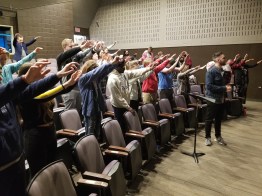 Finally, we received assurance of pardon, feted our grads, and closed in prayer. It was a wonderful, if earlier than preferred, way to send our students off into an unknown future. In like manner, may the Lord be with you as you navigate these uncharted waters (for most of us) in the weeks ahead!
 jazz musician Adam Neely’s most recent
 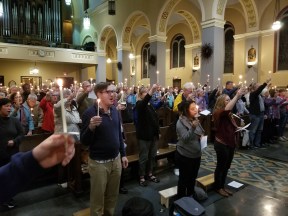 Especially when the subject of Taizé worship comes up. We happen to visit a church (
 a former student, had just finished (I found out later) leading one of the congregation’s favorite “Go, God” up-tempo numbers and, just as we walked in, felt led of the Holy Spirit to shift gears midstream into a (mostly) unscripted time of reflection. With a simple acoustic guitar providing a I-IV vamp underneath, he began speaking Truth to the congregation. Charismatics would have received them as prophetic words; Reformed believers would have called them exhortations. Call them what you want; they were exactly what I needed yesterday morning–and they certainly felt inspired by the Holy Spirit. Speaking occasionally in the third person and occasionally on behalf of the Almighty in the first person (while clearly making evident which was which), Tim welcomed those gathered into the fullness of the blessings of belonging to Christ . . . in a loving relationship. One phrase he uttered, “Jesus gently wants to wash away your cynicism today,” felt as if it had been given just for me.
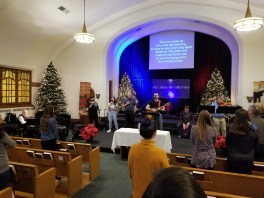 cases (and during the other songs in between), the congregation, about 100 in attendance, sounded like 500. Part of that was due to the architecture in the church (high ceiling, lots of wood on the floor along with a bit of carpet), which fosters resonant corporate song, but part of it had to do with the songs themselves (pretty familiar across generational lines) and how they were presented (piano, acoustic guitar, violin, and cajon). All three factors contributed to a rich congregational singing experience. (Notice the Christmas trees still up on the twelfth day of Christmas, the day before Epiphany. I love it when low-church fellowships embrace the liturgical calendar.)
 The above notwithstanding, I simply wasn’t prepared for the exuberance of the congregational singing yesterday morning. The whole room resounded in song. I could actually hear other voices with unusual clarity (for contemporary worship). I even asked the production team members afterward if they were piping the congregation through the house mix (they weren’t). If, as Aaron Niequist is fond of reminding worship leaders, the purpose of congregational singing is . . . wait for it . . . congregational singing, why don’t most congregations sound as robust as did those assembled yesterday morning? Here are three congregational-singing lessons for the other 11 months of the year to be learned from my Advent-worship experience yesterday.
 a
a  Emmaus Road Worshipers