
This is post number 41 in a series of random reflections I have been amassing over the past couple of years since retiring from steady, local-church, “weekend warrior” worship ministry. These ruminations are in no particular order, and they vary in significance. I welcome discussion on any of them.
Reflection #41: Now that I no longer receive a paycheck to go to church, I understand the desire to keep contemporary worship services to 75 minutes or fewer.
When I was a paid staff member at six different churches for most of my adult life, I never in a million years would have written the above statement without the dependent clause that begins the sentence. I knew enough about church history to assert that many believers in bygone eras devoted great swaths of their entire Sundays to corporate worship. The Sundays of my childhood and youth were spent in church most of the day–by the time you factored in Sunday School, morning worship, late-afternoon youth group, and evening worship. And some worshiping communities still today make corporate worship the focal point of lengthy and sustained time spent together each weekend as the Body of Christ (many African-American churches, for example).
I confess that when I was the staff member primarily in charge of worship service orders, I bristled internally whenever lay leaders (usually elders or deacons) raised concerns about service length. To my shame, I shamed them with unvoiced-but-deeply-felt holier-than-thou sentiments that equated the fervency of their faith walks with their willingness to support corporate worship that, on occasion, lasted for for an hour and a half or a bit longer. Now that I am a “mere” parishioner, I find myself looking at my watch with much greater frequency when services stray beyond the 75 minutes that seem to represent the de facto time limit for contemporary worship in evangelical America. I think more about how to get to the parking lot most efficiently, about where we might go out to lunch when the service concludes, about all kinds of other things that rarely crossed my mind when I was leading worship and wanting to emphasize one kernel of truth from the pastor’s sermon in my spoken introduction to the closing song.
In other words, now that I’m no longer praying about, laboring over, and rehearsing through worship services–when I’m, frankly, just showing up on Sunday morning in various stages of unpreparedness like the vast majority of lay congregants–I find (surprise) that my knee-jerk expectations for what transpires and (for the purposes of this post) how long it will all take have changed. In theory, my doctoral studies in worship inform each worship experience I attend, and not insignificantly; in practice, now that I’m not leading worship for a living each weekend, the degree doesn’t factor in all the time–and, when it does, it sometimes is the lens through which I justify a critical spirit.
 I confess this here because I guess, especially as I started my grad-school worship studies, I wish somebody had taken me aside with greater regularity and reminded me that shepherds generally have much more success when they guide graciously, and not much when they push indignantly (or while smiling through gritted teeth). Dr. Darrell Harris, founding chaplain of the Robert E. Webber Institute for Worship Studies, warned my classmates and me in the summer of 2003 that the education upon which we would soon embark would “ruin” us for ministry if we weren’t careful. He was right, and I wish I had sought his counsel a lot more than I did re: how to deal with that.
Worship leaders, it’s so hard to put ourselves in the mindset of our church family members (who, if we’re brutally honest, usually do not–and can not–care about corporate worship as much as we do). I would encourage you to try to do so much more often than I did when I was a worship leader.
Blessings for the starts of your ministry years this weekend. The Lord be with you!
 creatures and their day-and-night/never-stopping rendition of “Holy, Holy, Holy.”) Still, some songs do run the risk of becoming a bit bland near the end, so why not help the cause by taking the energy up a notch with a modulation? The classic example here is Darlene Zschech’s
 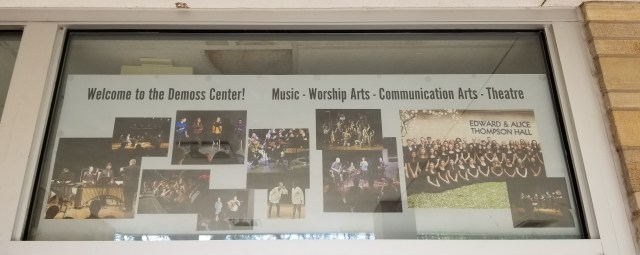 Today we welcome the Class of 2023 to my alma mater and employer, Judson University. The excitement on campus last week–both that of the student leaders who returned early on and the new students who arrived on Friday–was infectious. In my role as Director of the Demoss Center for Worship in the Performing Arts, I get to take an active role in helping articulate and facilitate the culture into which my colleagues and I receive the students the Lord brings to us. It’s an exciting time of the year, and, I confess, I still get butterflies every mid-August. (I think when I cease having that nervous energy, I’ll know it’ll be time to hang up the pedagogical spikes.)
 years or so, especially contemporary worship music (thanks, Adam Perez, right, for stating it so
 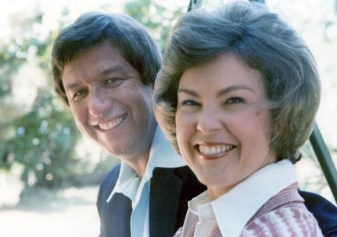 Sure, the Gaithers had contributed
  Mark Galli, of Christianity Today, is one of my favorite church-culture commentators, and, as I have mentioned recently, he just launched a new series, The Elusive Presence, that has, in my opinion, hit the mark on a number of topics. This past week he covered preaching in the contemporary American church in an article prophetically titled
  Transforming Presence: How the Holy Spirit Changes Everything–From the Inside Out, a new book from Daniel Henderson to which my mother introduced me, has some practical suggestions for avoiding both stiffness and rhetoric that promotes any number of inaccuracies re: the presence of God in our worship (particularly the notion that unless we do certain things when we gather God might not “show up” in our midst, the corporate worship version of putting the cart before the horse). This instead-of-that-try-this list (from which I am cherry-picking particular examples) appears in an appendix at the end of the text entitled “A New Covenant Worship Vocabulary”:
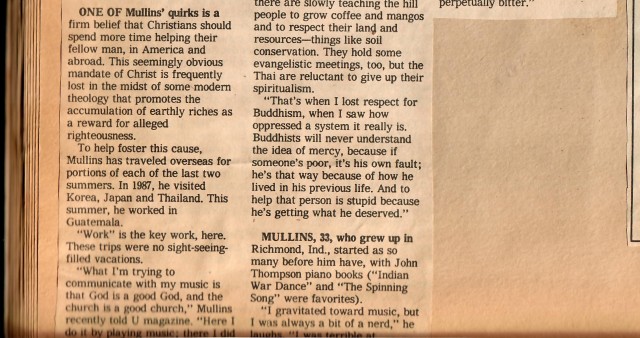
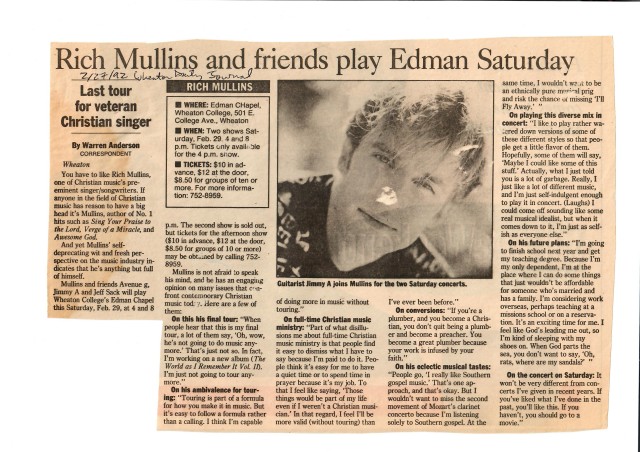
 Most of what I’ve saved has come from the creative energies of others, but while rummaging about the other day, I ran across a couple of articles I had written back when I was doing free-lance, feature-article/concert-review stringing for a couple of local papers, the Elgin Courier-News and, on rare occasion, the Wheaton Daily Journal. During those years, I had the pleasure of getting to know ccm singer/songwriter Rich Mullins at a very basic level. We weren’t drinking buddies or anything like that, but I did live next door to him one summer (fun story) when he stayed on Judson’s campus while recording in Elgin, and I did end up interviewing him on three separate occasions. We also brought him to chapel (the quid pro quo for his cheap rent that summer) when I was directing that ministry at Judson. It was enough so that had someone mentioned my name and put it in context for him, Rich might have said, “Oh, yeah–that guy at that school in Elgin.” That was about the extent of the depth of our relationship. (Some Elgin friends knew him better; in fact, Rich gave a house concert in their home a few weeks before he died. You can access a home movie of that concert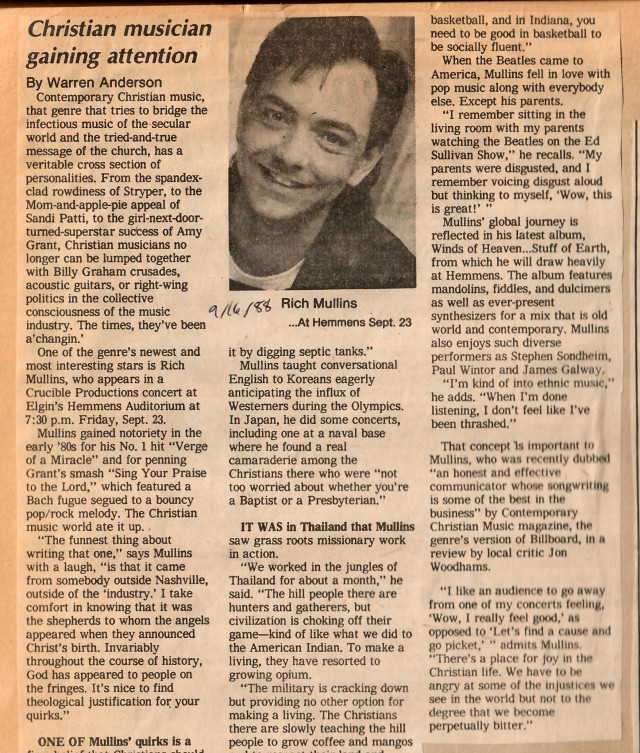
 . . . to introduce you to a fabulous music group that just released a full-length CD.
 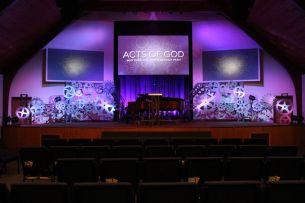 But we have visited a number of non-mainline churches that are doing some excellent and creative things with staging, lighting, and set design that go far beyond the mere pursuit of the trendy and cool, moving into metaphysical realms that can, in the best cases, lend meaning to the overall worship. (The accompanying pic comes from First Baptist Church in Elgin, Ill., where my former Judson University Worship Arts student, Joshua Hoegh, is the Worship and Creative Arts Pastor.) In an age where educators tell us more and more students learn best via
  Emmaus Road Worshipers